
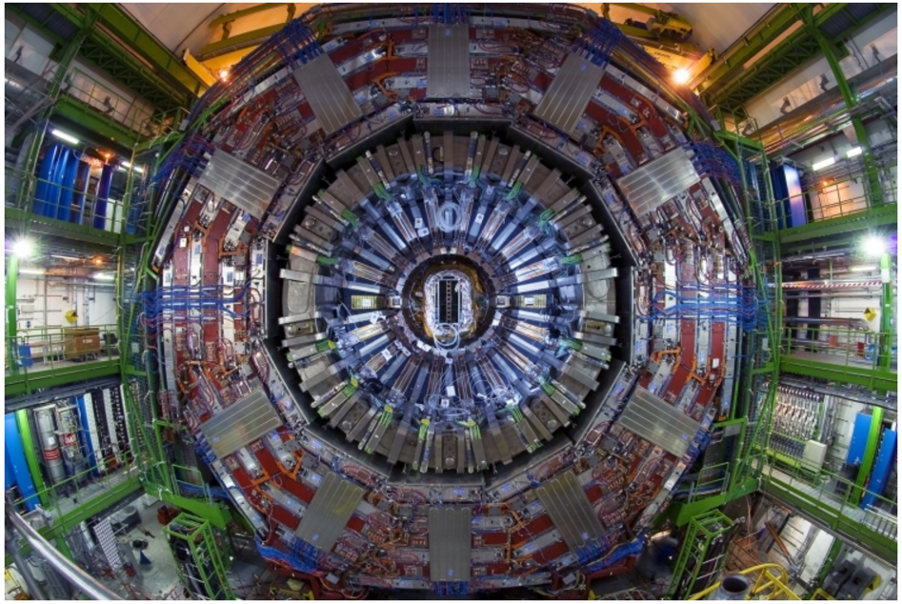
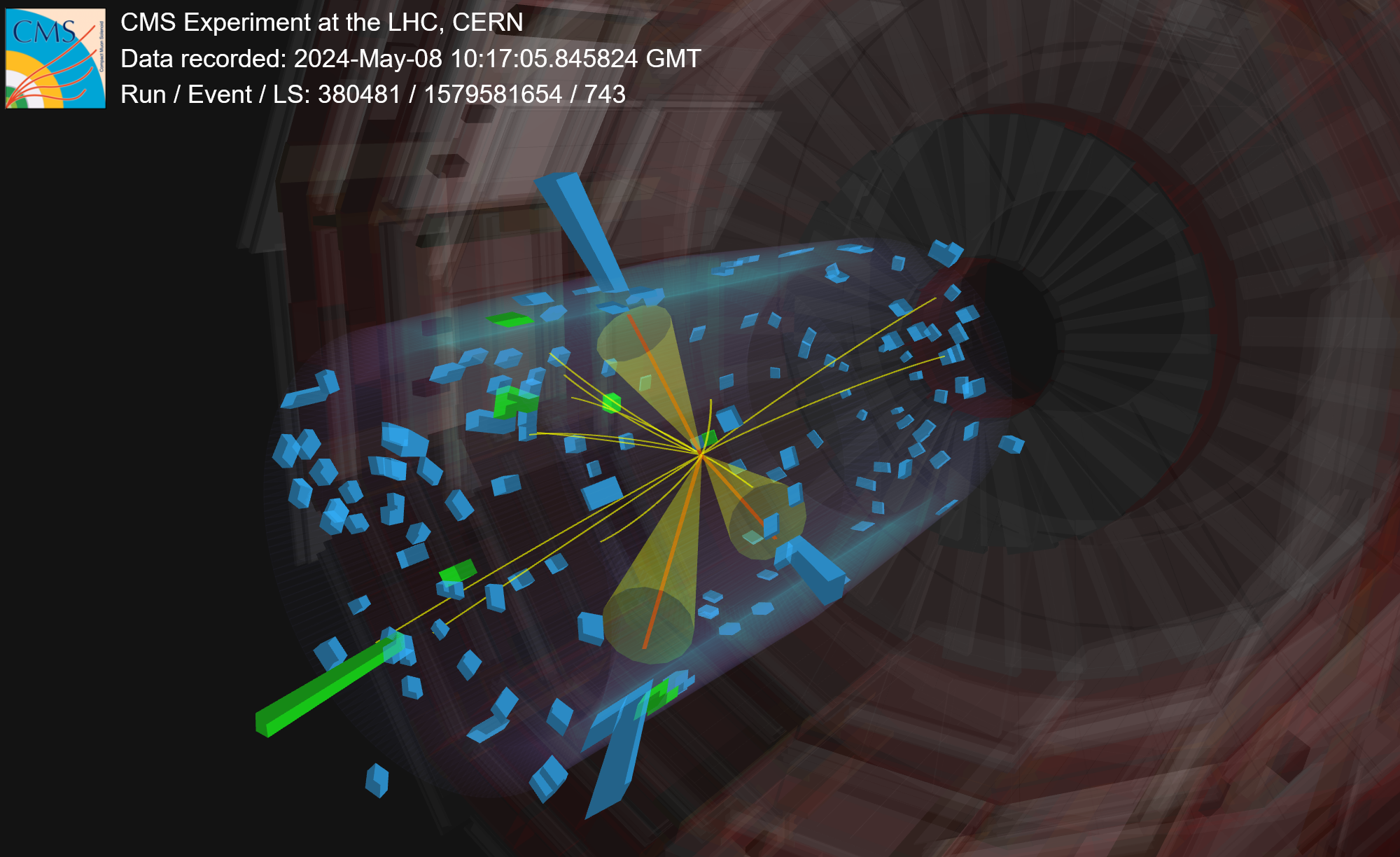
The CMS experiment utilises proton–proton collision data collected between 2016 and 2026 to search for rare decays of the W boson into three charged hadrons.
The W boson, which carries the weak nuclear force, was discovered at CERN in 1983 by the UA1 and UA2 experiments. It has since become one of the most thoroughly studied particles in high-energy physics – yet, some of its rarest decay modes remain unobserved. The CMS experiment has recently searched for its rare decay into three light charged hadrons, using 446 fb–1 of proton–proton collision data recorded between 2016 and 2026.
Typical decays of the W boson into hadrons result in an average of 30 final state particles, making it difficult to reconstruct with high accuracy and efficiency. A more feasible approach is to reconstruct W bosons from as few as three charged hadrons. With the Standard Model of particle physics predicting only between 1 and 100 W bosons out of 10 million decaying as such, this mode has yet to be observed. In addition, the observation of this process will provide an alternative approach to determine the W boson mass, which is currently obtained from decays of the W boson into leptons.
The recent CMS study relies on the fact that in addition to identifying charged hadrons from particle tracks in the detector, some can also be identified as arising from the hadronic decay of tau leptons, where the visible charged particle is thought to be accompanied by an undetected neutrino. This is crucial since the tighter tau lepton selection requirements – as well as a machine-learning classifier named “DeepTau” – can help distinguish the tau leptons from background electrons, muons, and jets.
Events are required to contain at least three hadron candidates. The two candidates with the highest transverse momentum must be reconstructed as hadronically decaying tau leptons. The third candidate is allowed to be a tau lepton candidate (called “high-purity” events) or an isolated charged-particle track (called “low-purity” events). The low-purity selection uses a lower transverse momentum threshold, doubling the number of expected signal events.
The search is performed by examining the invariant mass of the three hadrons. The signal is expected to be found near the W boson mass of 80 GeV. The dominant background arises from quantum chromodynamics (QCD), where a huge number of hadronic particles are produced. Another important background is the Drell-Yan (DY) process, in which a Z boson decays into two genuine tau leptons.
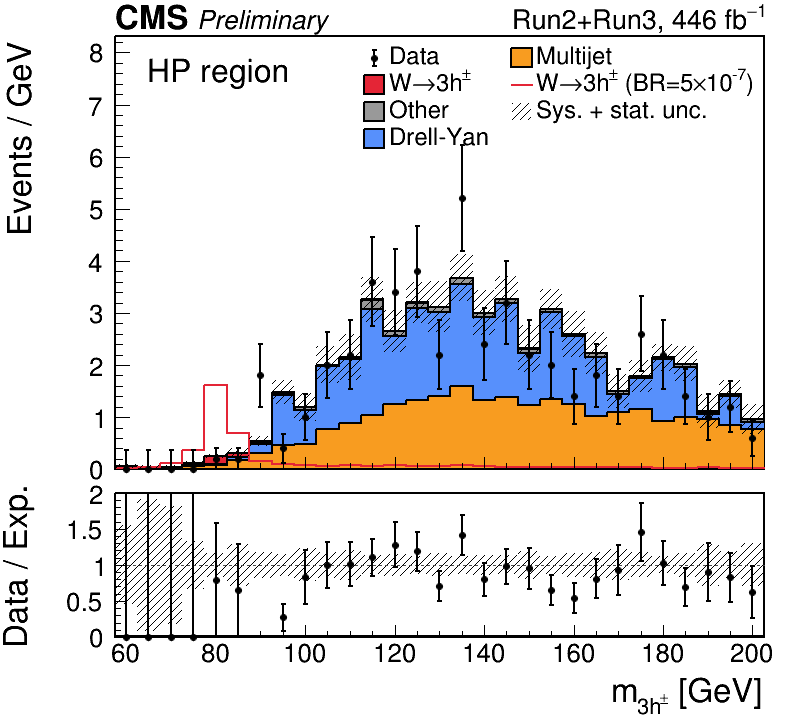
Above: Distribution of high-purity events over the invariant mass of the three-hadron system. The expected backgrounds are shown in orange (QCD), blue (DY), and gray (minor backgrounds). The best fit of the signal to the data is shown in red, stacked on top of the expected backgrounds. The red line also represents the signal, which has been scaled up for better visibility.
No significant excess of events consistent with W bosons decaying into three charged hadrons is observed. The study extracts a 95% confidence-level upper limit on the ratio of how often the W boson decays into three charged hadrons to all W-boson decays. The reported value, 2.4 × 10⁻⁷, is close to excluding the theoretical prediction of 10–7–10–5. One possible explanation of this tension is that the W boson could be dominantly decaying into an intermediate state of two particles, before going to the three hadron final state. This strongly reduces the angular separation of two of the three hadrons, making them not isolated from each other. Thus, such events might not be selected in the presented analysis. Another dedicated search for this particular final state would need to be performed to validate this statement.
Although the study has not observed the elusive signal of the W boson decaying into three charged hadrons yet, the result is already pushing our understanding of the interactions of the W boson. "This analysis furthers the study of hadronic W boson decay modes at the LHC, which will continue through the High-Lumi era," says James Natoli, now graduated PhD student from Kansas State University. As larger datasets become available, these rare decay modes will offer a new window on the dynamics of the W boson’s interactions.
Written by: Dennis Roy, for the CMS Collaboration
Edited by: Muhammad Ansar Iqbal
Read more about these results:
-
CMS Physics Analysis Summary (SMP-25-011): "Search for W boson decays to three charged hadrons"
-
@CMSExperiment on social media: Bluesky - Facebook - Instagram - LinkedIn - TikTok - Twitter/X - YouTube