
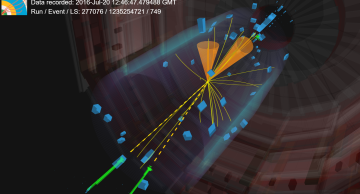
CMS has made the first search in the two-photon and two-bottom-quark final state for a heavy particle with masses from one to four trillion electronvolts.
In a first of its kind, CMS has carried out a search for a heavy particle, X, with masses…
News
|
adelanno |
Physics
|
maiqbal |
Physics
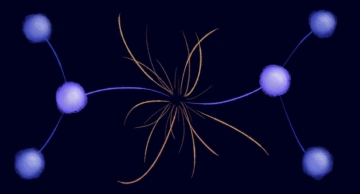
CMS advances the study of Higgs boson’s self-interaction by searching for Higgs boson pairs decaying into bottom quark–antiquark and tau lepton–antilepton pairs in collisions recorded between 2022 and 2024.
Is the Standard Model (SM) the…
|
adelanno |
Physics
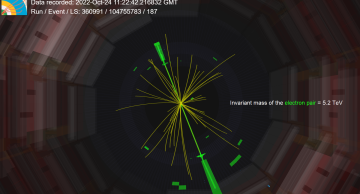
CMS probes the highest-energy lepton pairs ever recorded to search for hints pointing to a Higgs boson made of smaller constituents.
Is the Higgs boson truly an elementary particle, or could it be composed of more fundamental constituents? This…
|
maiqbal |
Physics
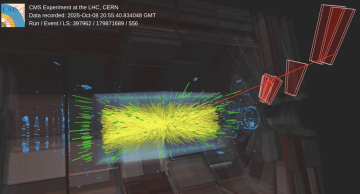
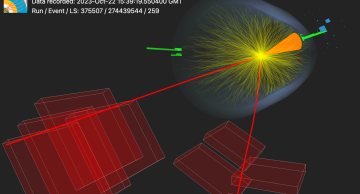
A special test run, with more than twice as many near-simultaneous collisions as usual, allowed CMS to test new methods of tracking and identifying particles, years before the upgraded High-Luminosity LHC comes online.
For a few days during…
|
adelanno |
Physics
Using Z bosons, the CMS experiment reveals new details of how the Quark-Gluon Plasma drains energy from energetic quarks and challenges current theoretical descriptions.
To understand the Quark-Gluon Plasma (QGP), the hottest matter in the Universe…

|
maiqbal |
Physics
The CMS Collaboration announces 28 new results for ICHEP 2026.
Among the highlights are three new results including 2026 data, and several brand new searches.
The CMS Collaboration is presenting a broad portfolio of new physics results at the…

|
sohurst |
Detector
One of the largest structures of CMS's future High Granularity Calorimeter (HGCAL) has successfully completed a demanding series of cold tests, marking an important milestone on the road to the High-Luminosity LHC and the next era of particle…

|
nstathak |
Collaboration
Hamamatsu Photonics K.K. was announced as the 2026 Industrial Award winner by the ATLAS and CMS Collaborations at a dedicated ceremony on 15 July.
With this award, the ATLAS and CMS Collaborations recognise the crucial role Hamamatsu Photonics K.K.…
|
adelanno |
Physics
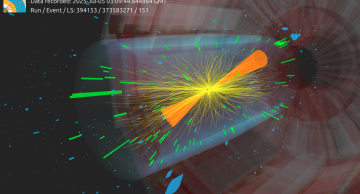
As high-transverse momentum particles punch through the plasma formed from light ions, the CMS experiment sees a possible imprint from the initial shape of the collisions
For the first time, CMS has observed both suppression of high transverse…
|
adelanno |
Physics
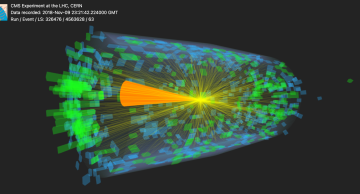
CMS investigates charm-quark jets in heavy-ion collisions and finds no evidence of additional radiation inside the dead cone
When lead ions collide at the Large Hadron Collider, they create an extreme state of matter known as the quark-gluon plasma…
|
maiqbal |
Physics
The CMS experiment reports the first observation of a “wake” created by a fast-moving parton in quark-gluon plasma.
Wake effect in quark-gluon plasma
When the LHC collides heavy nuclei, such as lead, at nearly the speed of light, it creates…
|
maiqbal |
Physics
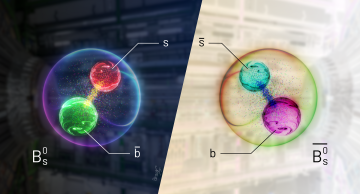
The CMS experiment uses its largest sample of B mesons to date to perform a high-precision test of subtle differences between matter and antimatter.
One of the greatest mysteries in physics is why our universe is made almost entirely of…