
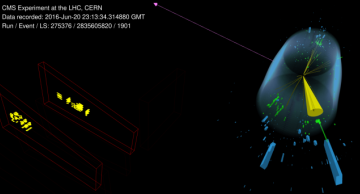
Most searches for new physics beyond the standard model (SM) focus on particles that decay almost instantly after being produced. However, many theories predict particles that travel a long distance, even up to meters, before decaying. Observing…
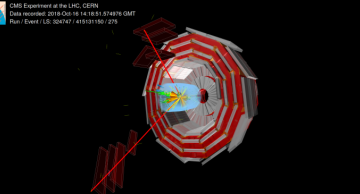
We have this idea that we communicate best within our own generation, but is this true? Who is to say that a second-generation lepton and a third-generation quark have nothing in common? Many observed phenomena in particle physics are conspicuously…
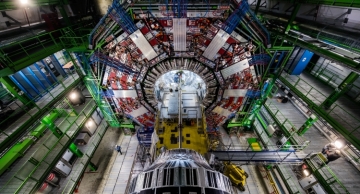
The CMS experiment at the LHC is set to explore the fundamental nature of our universe. It allows scientists to study particles, their interactions, and the forces that shape our world. Through these studies, a deeper understanding of the building…
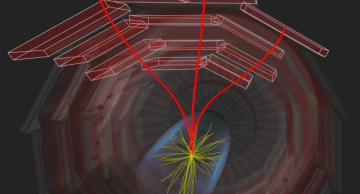
It was 1918 when the mathematician Emmy Noether published what is known as her most famous theorem, revealing the fundamental relation between the symmetries of a physical system and the laws enforcing the conservation of some of its characteristic…
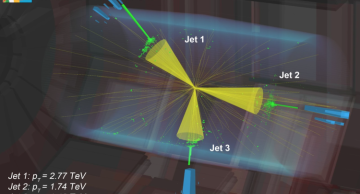
Three-jet event with an invariant mass of 7.2 TeV, showing the jets (yellow cones) and the energy deposited in the electromagnetic (green) and hadron (blue) calorimeters.
With the discovery of the Higgs boson, the Standard Model of particle physics…
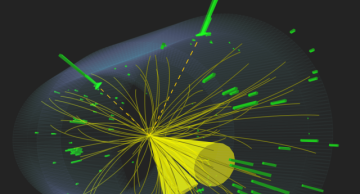
In 2012, the ATLAS and CMS Collaborations observed a new boson with a mass of 125 GeV, whose properties are compatible with those of the Higgs boson predicted by the Standard Model (SM) of particle physics. However, numerous models beyond the…
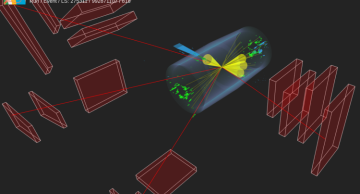
The CMS Collaboration has recently reported a new study of ZZ+jets production, a process described by the Standard Model of particle physics. The goal of such measurements is to compare the observed results with the theoretical predictions; any…
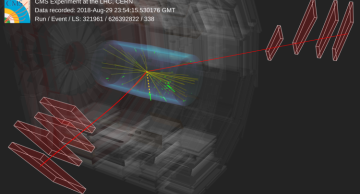
The discovery of the Higgs boson in 2012 marked a significant milestone in particle physics. Since then, researchers at the ATLAS and CMS Collaborations have been diligently investigating its properties and probing for rare production and decay…
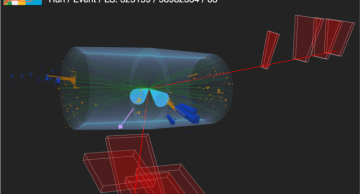
The standard model (SM) of particle physics is by far the most successful theory describing the experimental observations of particle interactions. Most of the SM interactions preserve the “flavor” of the elementary particles, with the exception of…
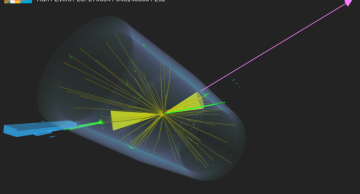
The top quark is now a full grown adult - it’s been almost 30 years since its discovery at Fermilab! - and being the heaviest brick of the Standard Model it plays a big part in the Universe. It is a bit like a celebrity in the world of particle…
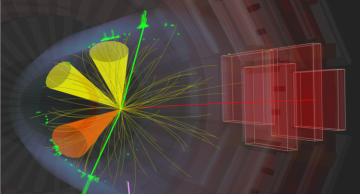
In the thrilling world of particle physics, our mission at the Large Hadron Collider (LHC) is to explore the mysteries of the universe by conducting experiments and pushing the boundaries of the Standard Model (SM). The SM is a wonderful theoretical…
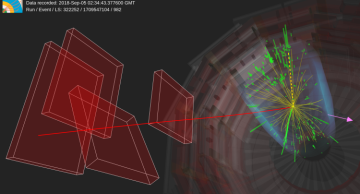
Bosons are elementary particles in the field of particle physics, distinguished by having a spin quantum number with an integer value. They play a crucial role in mediating the fundamental forces of nature, including the electromagnetic force and…