
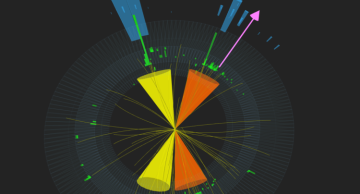
The standard model (SM) of particle physics, is the most successful theory describing the behaviour of elementary particles and their interactions. However, the SM has a few serious shortcomings, such as the Higgs boson mass problem. The mass of the…
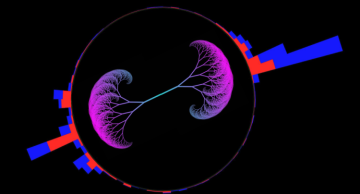
Quarks and gluons are the elementary particles that make up protons and neutrons, which are in turn the building blocks of the nucleus of every atom. Gluons are the particles that mediate the strong nuclear force, which is responsible for “gluing”…
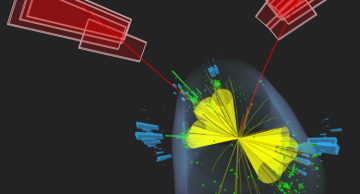
The standard model of particle physics (SM) is one of the most precise theories ever conceived, capable of predicting certain quantities with up to 14 digits of precision. The LHC is a marvel of modern experimental physics and precision…
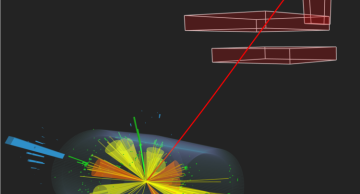
CMS observed the simultaneous production of four top quarks, one of the rarest physics processes ever observed at the LHC, opening the door to detailed searches for physics beyond the Standard Model (SM).
Ever since its discovery at the…
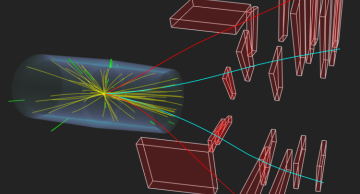
For over two millennia, people have wondered about the diversity of the material world, asking questions like “what are things made of?”. In the early decades of the 20th century we figured out that all things are composed of electrons, protons…
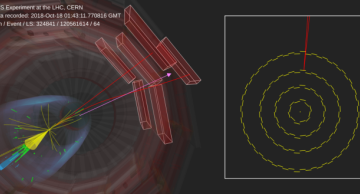
Dark matter is mysterious. In some ways, we know a lot about it, including its average density in the universe and upper limits for how strongly the dark matter particles might interact with each other or with “normal” Standard Model particles. In…
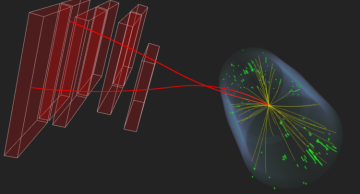
Experimental particle physics is like a game of hide and seek. Physicists endeavor to seek what is hidden by exploring all the possibilities. The hidden truths, which interpret the rules of nature, lie within elementary particles and how they…
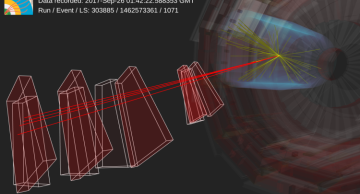
The amount of data that CMS has collected so far is truly astounding, thanks to the very large number of proton-proton collisions that the LHC has provided, over more than a decade, and to the large rate of events that CMS can record. And yet, even…
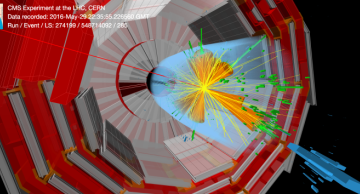
The CMS collaboration has seen evidence of a rare mechanism to produce four top quarks. The simultaneous production of four top quarks is predicted by the standard model and, as a bonus, the process is sensitive to many hypothetical undiscovered…
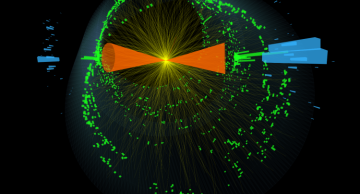
Imagine you are at a museum. After a long day admiring the exhibitions, you are exiting the museum. But to be able to get out, you will need to exit through the gift shop. The layout of the gift shop can be set up in several ways. Maybe you can take…
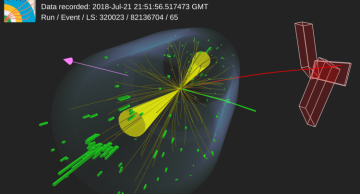
It was a bit more than 10 years ago that together with our colleagues from the ATLAS experiment, we at CMS announced the discovery of this new (and quite amazing) particle. Now, detecting a new fundamental particle is no easy feat; in these 10 years…
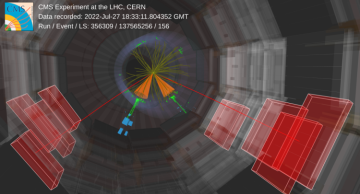
On 5 July 2022, the LHC surpassed the previous energy limits of experimental particle physics, breaking its own record by achieving stable proton-proton collisions at a center-of-mass energy of √s = 13.6 TeV. This marked the start of Run 3, the…