

Constructing the endcap HCAL (HE) was the responsibility of the Russian and Dubna (RDMS) groups. The endcaps consist of 17 layers of dense absorber plates that take energy from hadrons and muons emerging from collisions and, together with plastic…
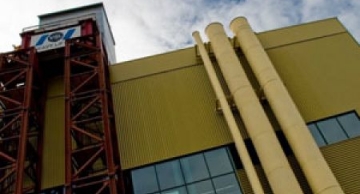
Trials and Tribulations of Heavy Lowering
Ten companies internationally were capable of taking on such a project as CMS, but VSL Heavy Lifting, a Swiss company, were the eventual winners of the 2 million CHF contract.
Though VSL were used to…
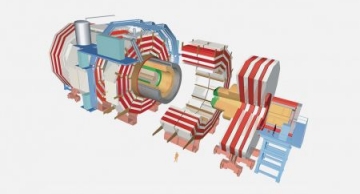
The decision to employ a method that involves hoisting thousands of tonnes of expensive machinery, the result of endless hours of work, down a 100 metre gaping hole was never going to be taken lightly. But CMS’s unique method of slicing up…
Between 1998 and 2005 a total of almost 250,000 m3 of soil and rock was excavated from the CMS site at “Point 5” of the LHC, in Cessy. The contractors - Seli, an Italian company and Dragados, Spanish - had previously worked on the Madrid metro but…
The CMS cavern, at Point 5 of the LHC near Cessy, was excavated from scratch in an old LEP (a previous CERN accelerator, the Large Electron Positron Collider) access point. The work, which took six and a half years, finishing in February 2005,…
Even when whittled down by the trigger system, CMS still produces a huge amount of data that must be analysed, more than five petabytes per year when running at peak performance. To meet this challenge, the LHC employs a novel computing system, a…
When CMS is performing at its peak, about one billion proton-proton interactions will take place every second inside the detector. There is no way that data from all these events could be read out, and even if they could, most would be less likely…
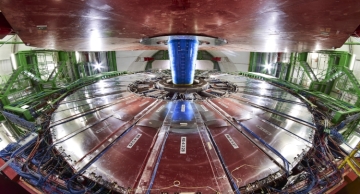
Resistive Plate Chambers (RPCs) are fast gaseous detectors that provide a muon trigger system parallel to those of the DTs and CSCs.
RPCs consist of two parallel plates, a positively-charged anode and a negatively-charged cathode, both made of a…
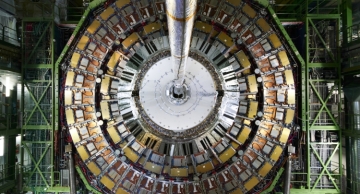
Cathode strip chambers (CSC) are used in the endcap disks where the magnetic field is uneven and particle rates are higher than in the barrel.
CSCs consist of arrays of positively-charged anode wires crossed with negatively-charged copper cathode…
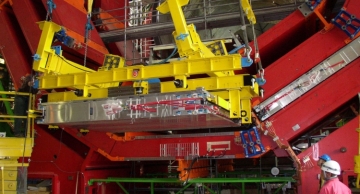
The drift tube (DT) system measures and identifies muon tracks in the barrel part of the detector. Each 4cm-wide tube contains a stretched wire within a gas volume. When a muon or any charged particle passes through the volume, it knocks electrons…

As the name “Compact Muon Solenoid” suggests, detecting muons is one of the most important tasks of CMS. Muons are charged particles that are just like electrons and positrons, but 200 times heavier. We expect them to be produced in the decay…
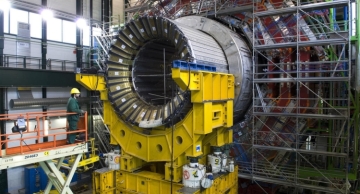
The Hadron Calorimeter (HCAL) measures the energy of “hadrons”, particles made of quarks and gluons (for example protons, neutrons, pions and kaons). Additionally it provides indirect measurement of the presence of non-interacting, uncharged…