

A crystal’s journey from creation to its place within the CMS electromagnetic calorimeter is an arduous one: its trials include travelling thousands of miles, being sawed and polished, as well as being heated to 1,165oC and cooled to 18oC.
The…
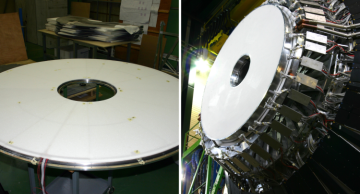
One way the Higgs boson might decay is into high-energy photons and detecting them is one of the ECAL’s primary functions. However, short-lived particles called neutral pions, also produced in collisions, can inadvertently mimic high-energy photons…
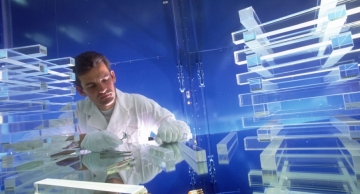
CMS uses lead tungstate (PbWO4) for the almost 80,000 crystals: a material with high density that produces scintillation light in fast, small, well-defined photon showers. This means the calorimeter system can be very precise and very compact,…

In order to build up a picture of events occurring in the LHC, CMS must measure the energies of emerging particles. Of particular interest are electrons and photons, because of their use in discovering the Higgs boson and other new physics.
The…
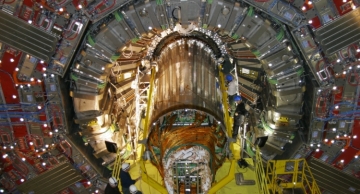
After the pixels and on their way out of the tracker, particles pass through ten layers of silicon strip detectors, reaching out to a radius of 130 centimetres.
The silicon strip detector consists of four inner barrel (TIB) layers assembled…
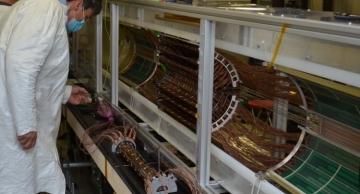
The pixel detector contains 124 million pixels, allowing it to track the paths of particles emerging from the collision with extreme precision. It is also the closest detector to the beam pipe, with cylindrical layers roughly at 3cm, 7cm,…

The measurement of the momentum of particles is crucial in helping us to build up a picture of what happens at the heart of the collision. One method to calculate the momentum of a particle is to track its path through a magnetic field; the more…
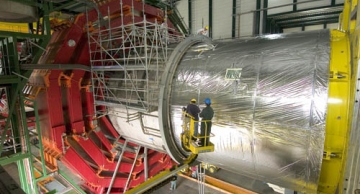
The CMS magnet is the central device around which the experiment is built, with a 4 Tesla magnetic field that is 100,000 times stronger than the Earth’s.
Its job is to bend the paths of particles emerging from high-energy collisions in the LHC. The…
The CMS experiment is 21 m long, 15 m wide and 15 m high, and sits in a cavern that could contain all the residents of Geneva; albeit not comfortably.
The detector is like a giant filter, where each layer is designed to stop, track or measure a…
It may seem strange that to record the Universe’s tiniest constituents we need the world’s most powerful machines and detectors. But the detector needs to be big because the particles flying out of the collisions have such high energies that it…
Each particle that emerges from an LHC collision is like a piece of a puzzle, with some of these pieces breaking up further as they travel away from the collision. Each leaves a trace in the detector and CMS’s job is to gather up information about…
Detectors consist of layers of material that exploit the different properties of particles to catch and measure the energy and momentum of each one. CMS needed:
a high performance system to detect and measure muons,
a high resolution method to…