
Category: Physics
-
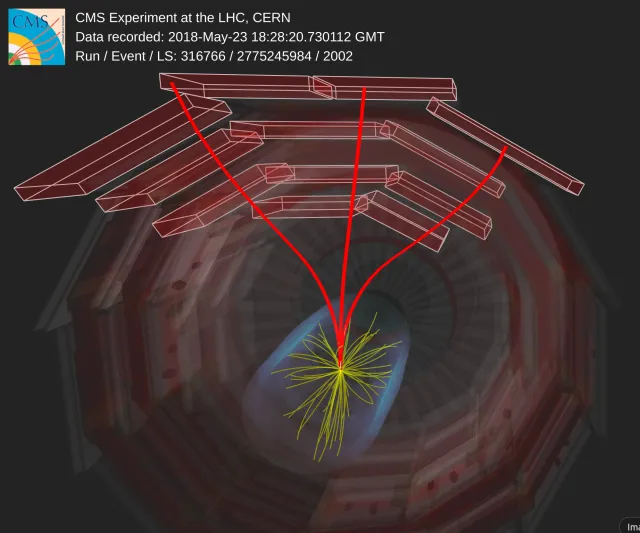
Flavoured Mysteries: searching for the tau lepton’s 3 muon decay
It was 1918 when the mathematician Emmy Noether published what is known as her most famous theorem, revealing the fundamental relation between the symmetries of a physical system and the laws enforcing the conservation of some of its characteristic quantities.
-
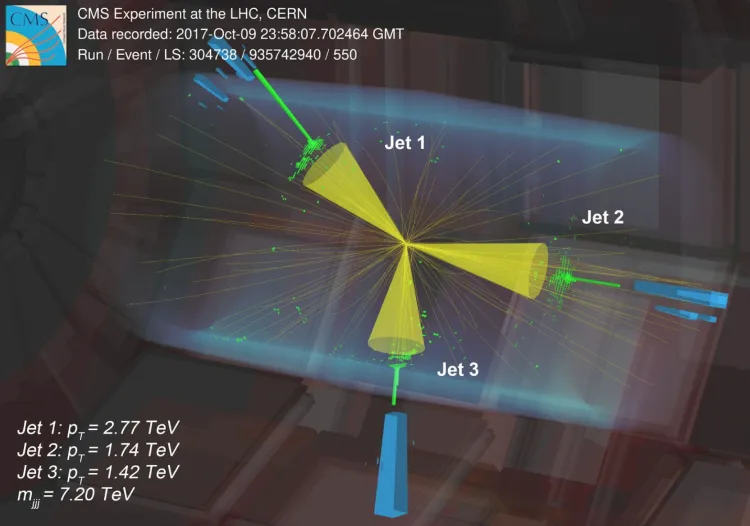
Three is a charm!
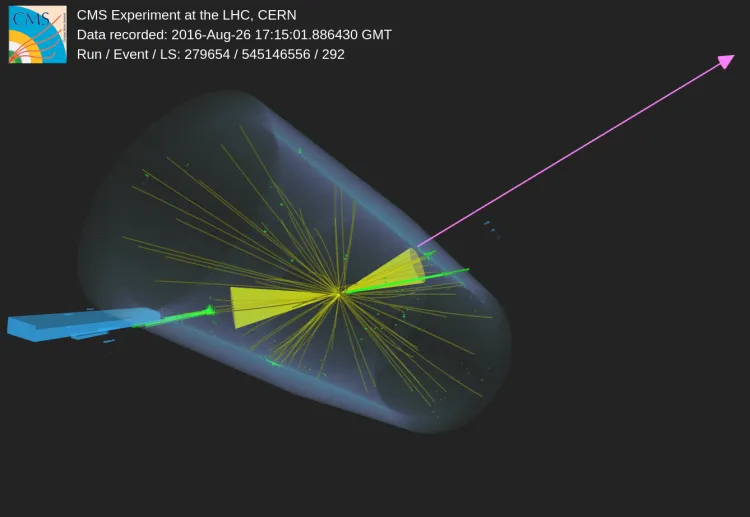
Three-jet event with an invariant mass of 7.2 TeV, showing the jets (yellow cones) and the energy deposited in the electromagnetic (green) and hadron (blue) calorimeters.
-
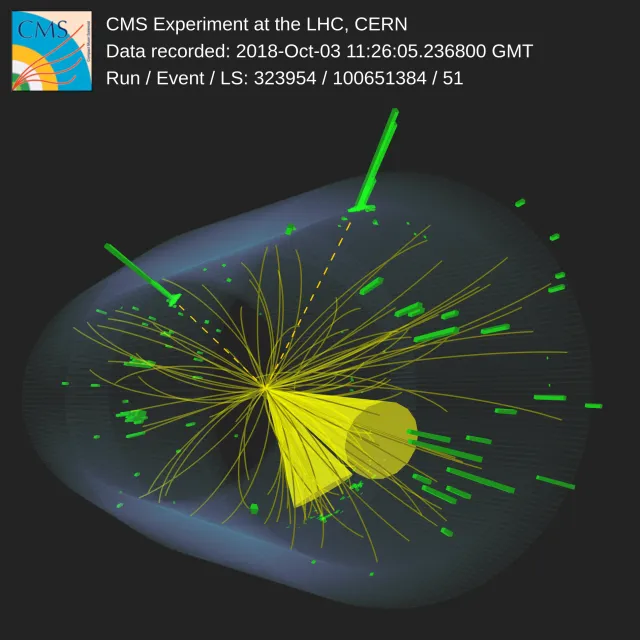
What if there was a second and lighter Higgs boson?
In 2012, the ATLAS and CMS Collaborations observed a new boson with a mass of 125 GeV, whose properties are compatible with those of the Higgs boson predicted by the Standard Model (SM) of particle physics.
-
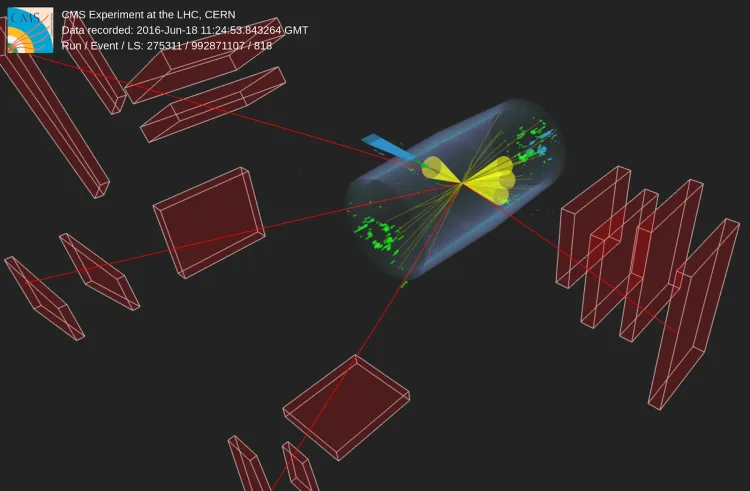
A Step Deeper into Elementary Particle Interactions with ZZ+jets
The CMS Collaboration has recently reported a new study of ZZ+jets production, a process described by the Standard Model of particle physics.
-
CMS at LHCP 2023
CMS presented a series of new results at the annual LHCP conference, which took place in Belgrade, Serbia.
-
LHC experiments see first evidence for rare Higgs boson decay into two different bosons
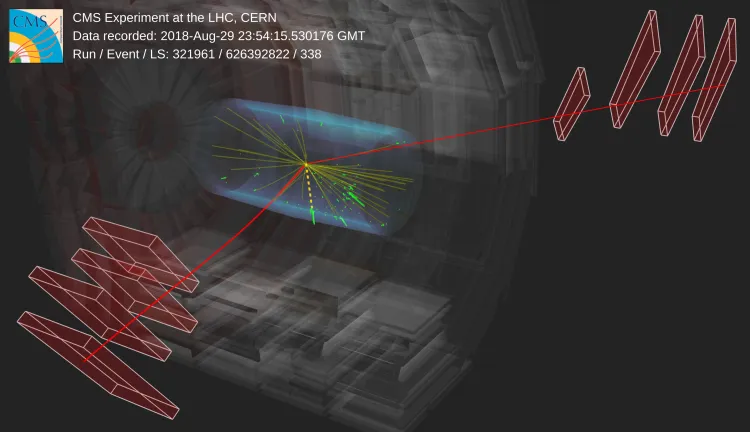
The discovery of the Higgs boson in 2012 marked a significant milestone in particle physics.
-
Muons meet beauty and the strange at CMS
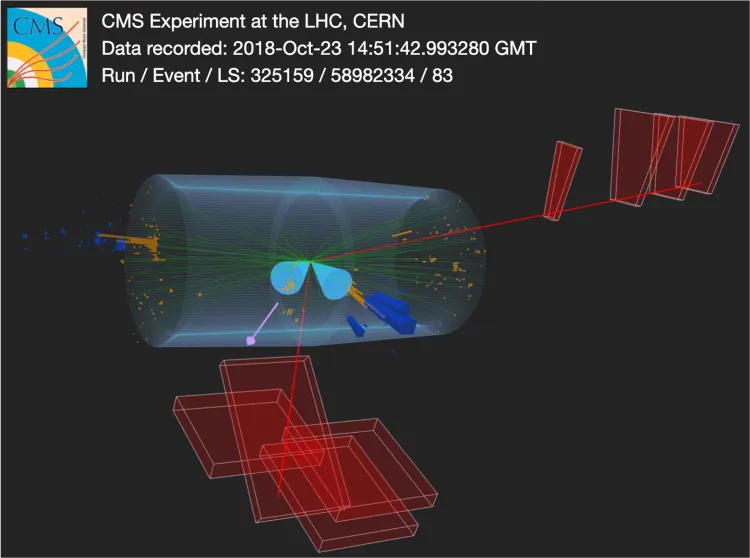
The standard model (SM) of particle physics is by far the most successful theory describing the experimental observations of particle interactions.
-
The beauty, the top, and the mighty
The top quark is now a full grown adult – it’s been almost 30 years since its discovery at Fermilab!
-
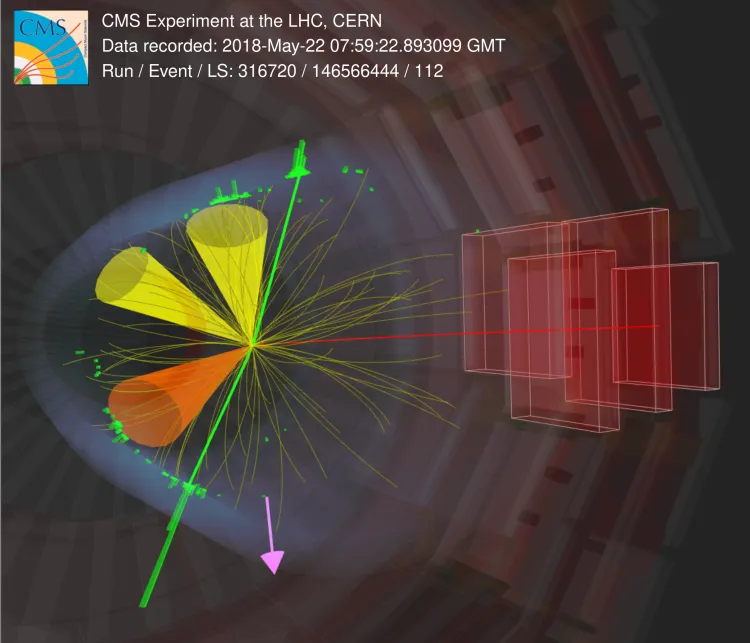
Unveiling the tWZ process: where no one has ever looked before
In the thrilling world of particle physics, our mission at the Large Hadron Collider (LHC) is to explore the mysteries of the universe by conducting experiments and pushing the boundaries of the Standard Model (SM).
-
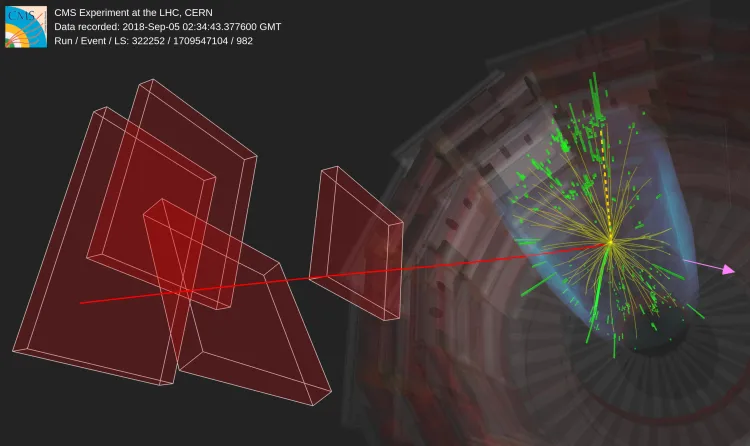
A new tri-boson process discovery
Bosons are elementary particles in the field of particle physics, distinguished by having a spin quantum number with an integer value.