
Tag: Run 2
-
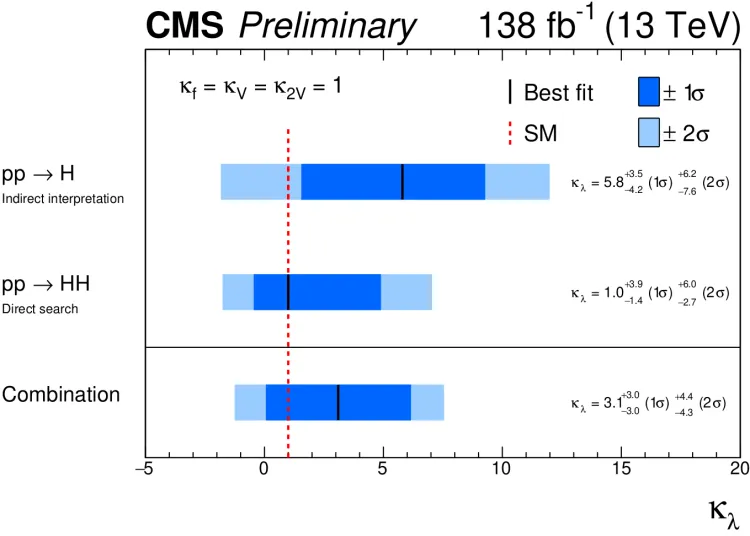
The Higgs boson, as it intracts with itself
The Higgs boson plays a crucial role in the standard model of particle physics.
-
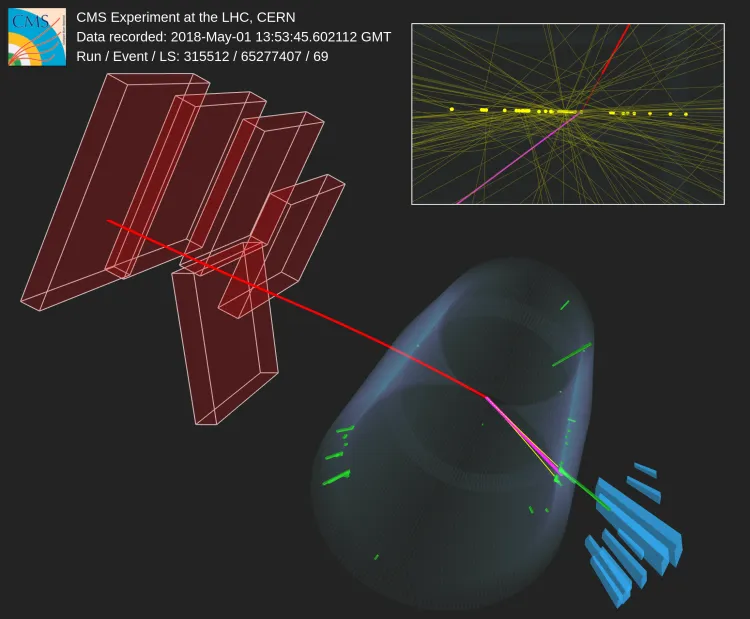
Disclosing quantum corrections to electromagnetic interactions of tau leptons
In quantum electrodynamics (QED), the quantum theory of electromagnetic interactions, the magnetic dipole moment of a particle acquires quantum corrections originating from interactions with virtual photons and other particles, often referred to as the anomalous magnetic moment of that particle.
-
A dark world ruled by a strong force
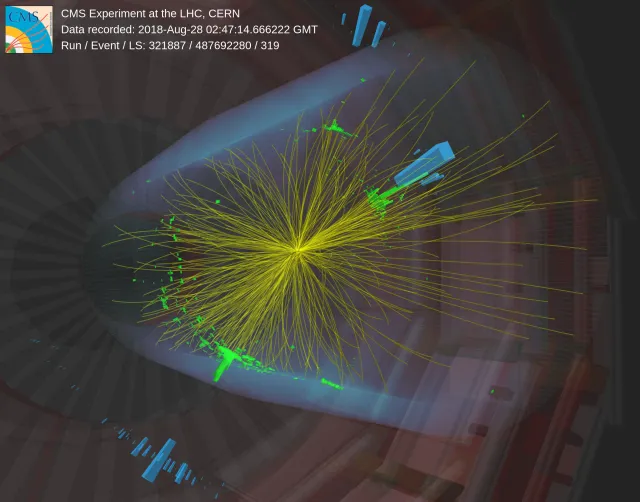
Above: Event display for a potential SUEP event, recorded at CMS in 2018, showing the characteristically high multiplicity of soft tracks in yellow.
-
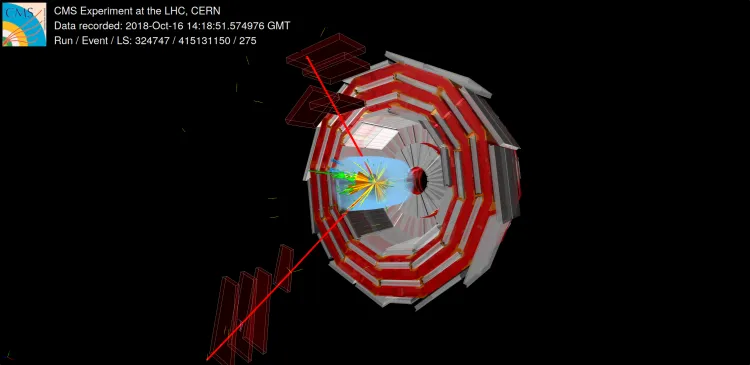
Using Machine Learning to find good muons
The CMS experiment at the LHC is set to explore the fundamental nature of our universe.
-
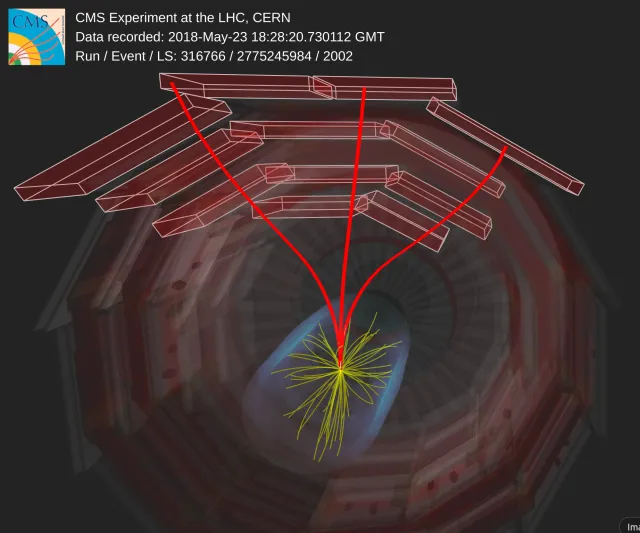
Flavoured Mysteries: searching for the tau lepton’s 3 muon decay
It was 1918 when the mathematician Emmy Noether published what is known as her most famous theorem, revealing the fundamental relation between the symmetries of a physical system and the laws enforcing the conservation of some of its characteristic quantities.
-
Three is a charm!
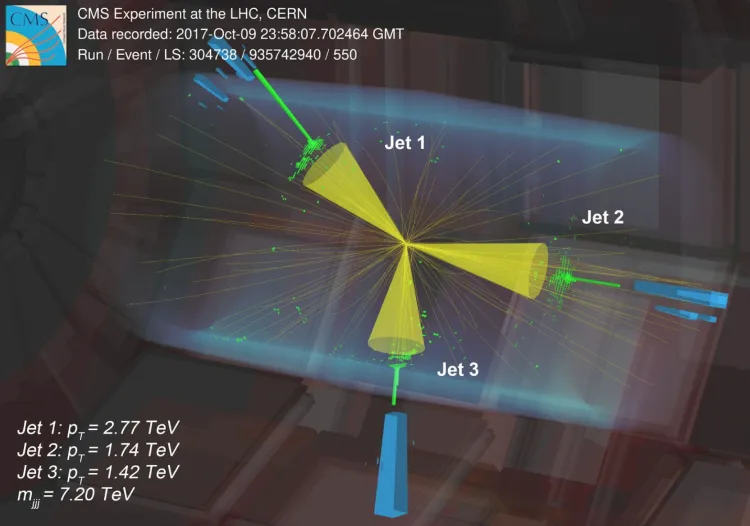
Three-jet event with an invariant mass of 7.2 TeV, showing the jets (yellow cones) and the energy deposited in the electromagnetic (green) and hadron (blue) calorimeters.
-
What if there was a second and lighter Higgs boson?
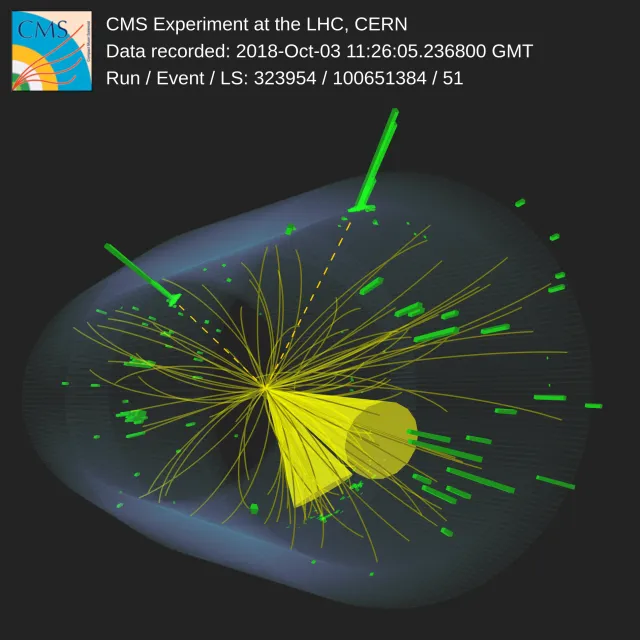
In 2012, the ATLAS and CMS Collaborations observed a new boson with a mass of 125 GeV, whose properties are compatible with those of the Higgs boson predicted by the Standard Model (SM) of particle physics.
-
A Step Deeper into Elementary Particle Interactions with ZZ+jets
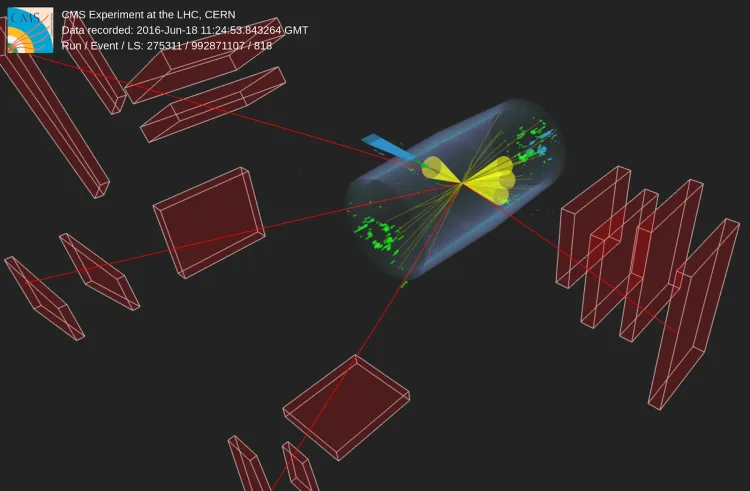
The CMS Collaboration has recently reported a new study of ZZ+jets production, a process described by the Standard Model of particle physics.
-
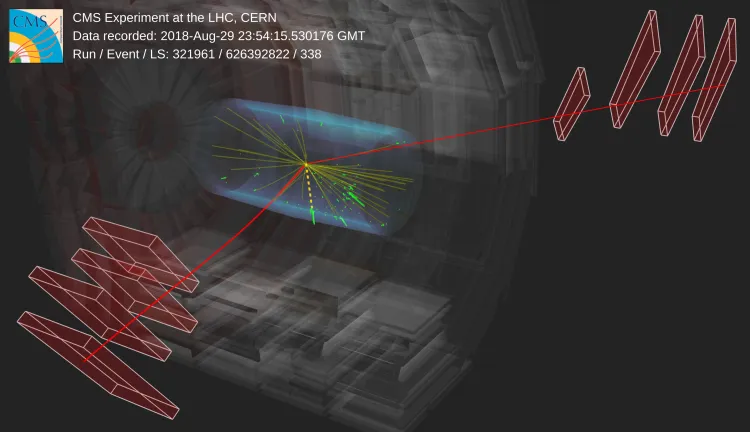
LHC experiments see first evidence for rare Higgs boson decay into two different bosons
The discovery of the Higgs boson in 2012 marked a significant milestone in particle physics.
-
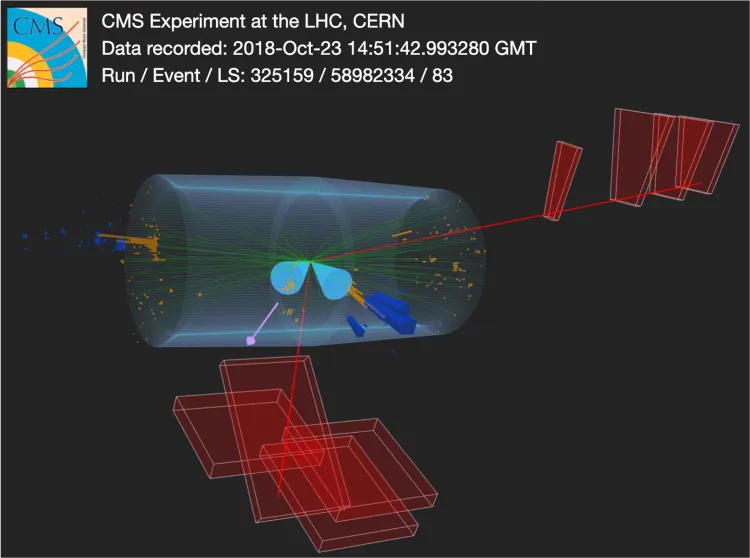
Muons meet beauty and the strange at CMS
The standard model (SM) of particle physics is by far the most successful theory describing the experimental observations of particle interactions.