
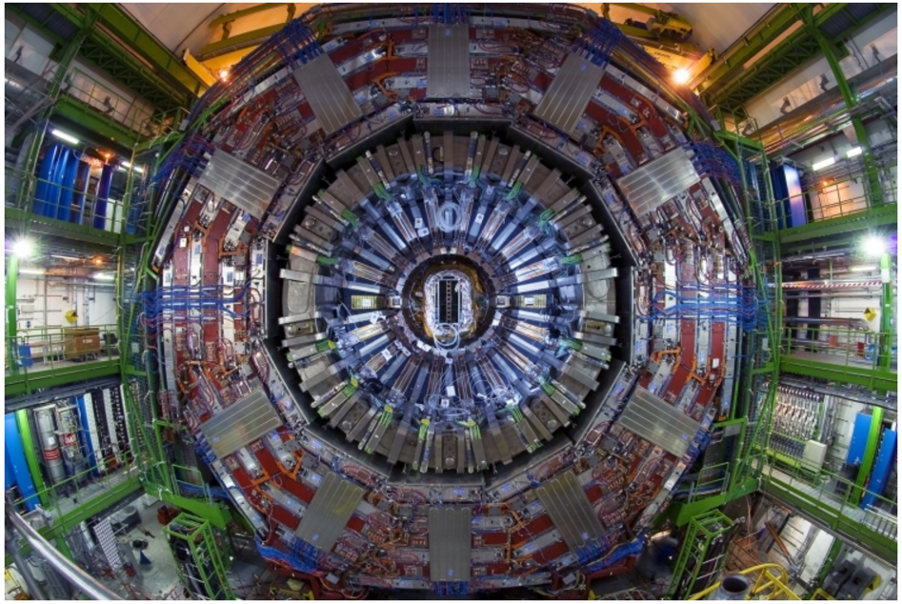
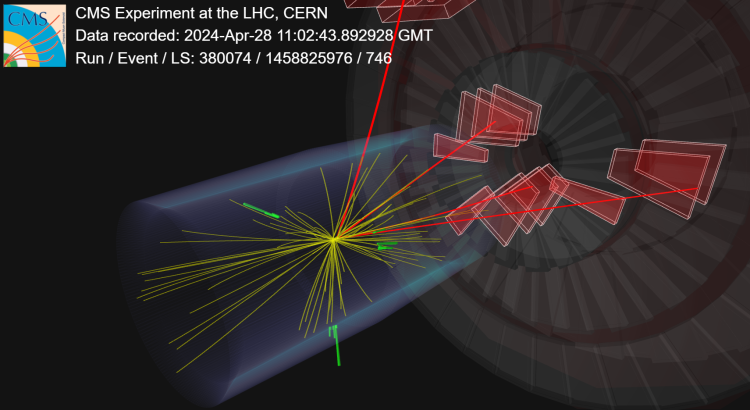
The CMS experiment uses data collected between 2022 and 2024 to perform a detailed study of Higgs boson production rates as a function of several variables. The measurements focus on the “golden channel”, characterized by four leptons (electrons or muons) in the final state.
One of the cleanest ways to study the Higgs boson is through its decay into four leptons (electrons or muons) via two Z bosons: H → ZZ* → 4ℓ. Although this decay occurs in only a very small fraction of Higgs boson events (approximately 0.01% of all decays!) it provides an exceptionally clear signature. Electrons deposit their energy in the electromagnetic calorimeter and leave tracks in the inner tracking system, while muons pass through the interior of the detector and are recorded in dedicated muon subdetectors . Because all four final-state particles are reconstructed with high precision, physicists can measure their energies and momenta accurately.
For this result, the CMS experiment utilised 171 fb–1 of data collected during 2022–2024, at the unprecedented centre-of-mass energy of 13.6 TeV.
Achieving high precision demands continual improvements and constant advances in both detector performance and data analysis. During Run 3, substantial effort has gone into refining the calibration and alignment of the tracking system, improving how accurately electron energies are measured, and sharpening the measurement of muon momenta. At the same time, new reconstruction techniques have been developed to handle the far busier collision environment, where many proton–proton interactions occur simultaneously in a single event. Together, these improvements make the Higgs boson signal clearer, sharpen the reconstructed mass, and reduce uncertainties in the measurement.
By precisely reconstructing the four final-state leptons, the mass of the parent Higgs boson can be inferred. In data, this appears as a distinct peak around 125 GeV rising above a relatively smooth background, mainly stemming from direct production of pairs of Z bosons. The figure below demonstrates this using the 2022–2024 CMS data.
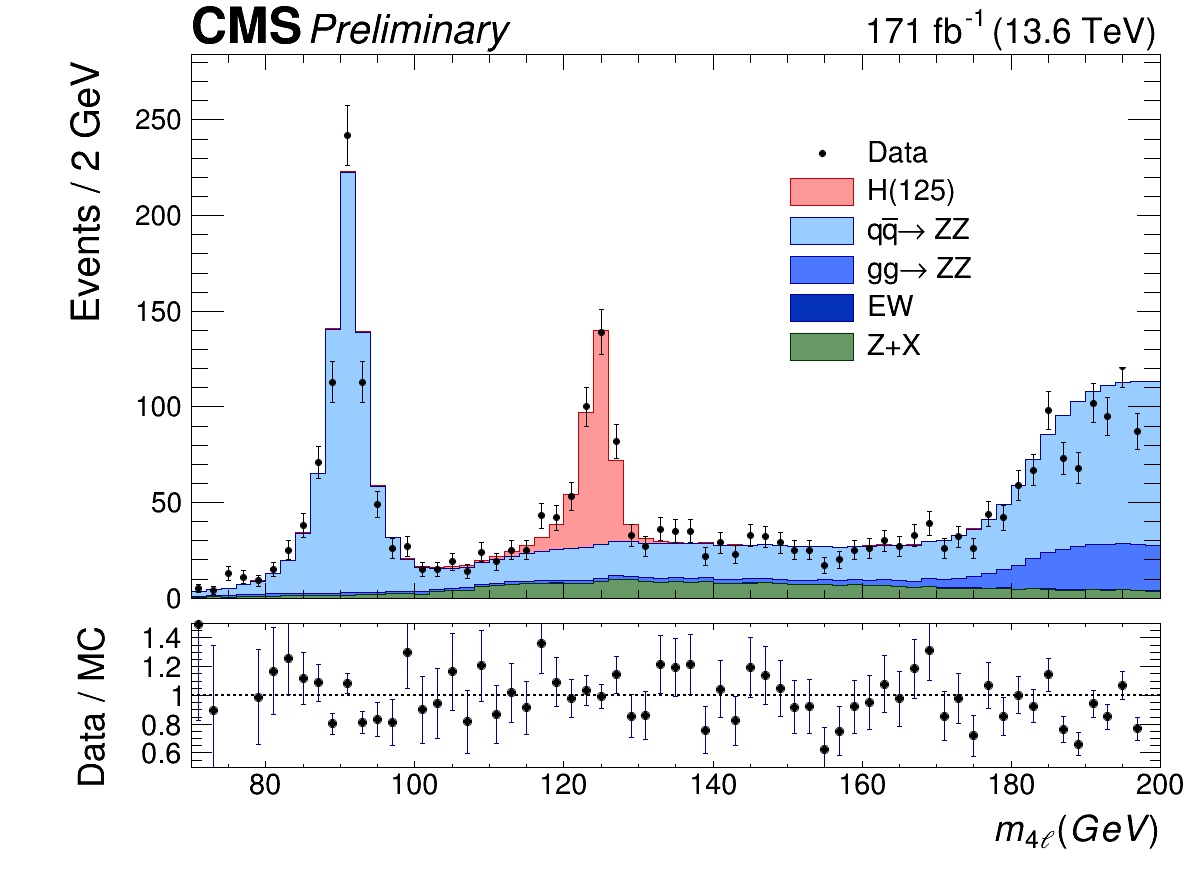
Above: Distribution of the invariant mass of the four-lepton system. The Higgs boson appears as a peak on top of the smooth background.
With nearly twenty times more data than at the time of the Higgs boson discovery, CMS has moved well beyond merely confirming the Higgs boson’s existence, and is now able to study its properties in detail. This analysis measures not only the total production rate, or “cross section”, of the Higgs boson in the four-lepton decay channel, but also how this rate changes with different kinematic properties. For example, physicists study how often the Higgs is produced with high momentum, how many additional jets are produced in the same event, and even the angles between decay leptons. To confirm our findings rigorously, statistical analysis is performed, resulting in “differential” cross section measurements. These measurements offer deeper insight into the underlying mechanisms from which the Higgs boson can be produced and allow for precise comparisons with state-of-the-art theoretical calculations.
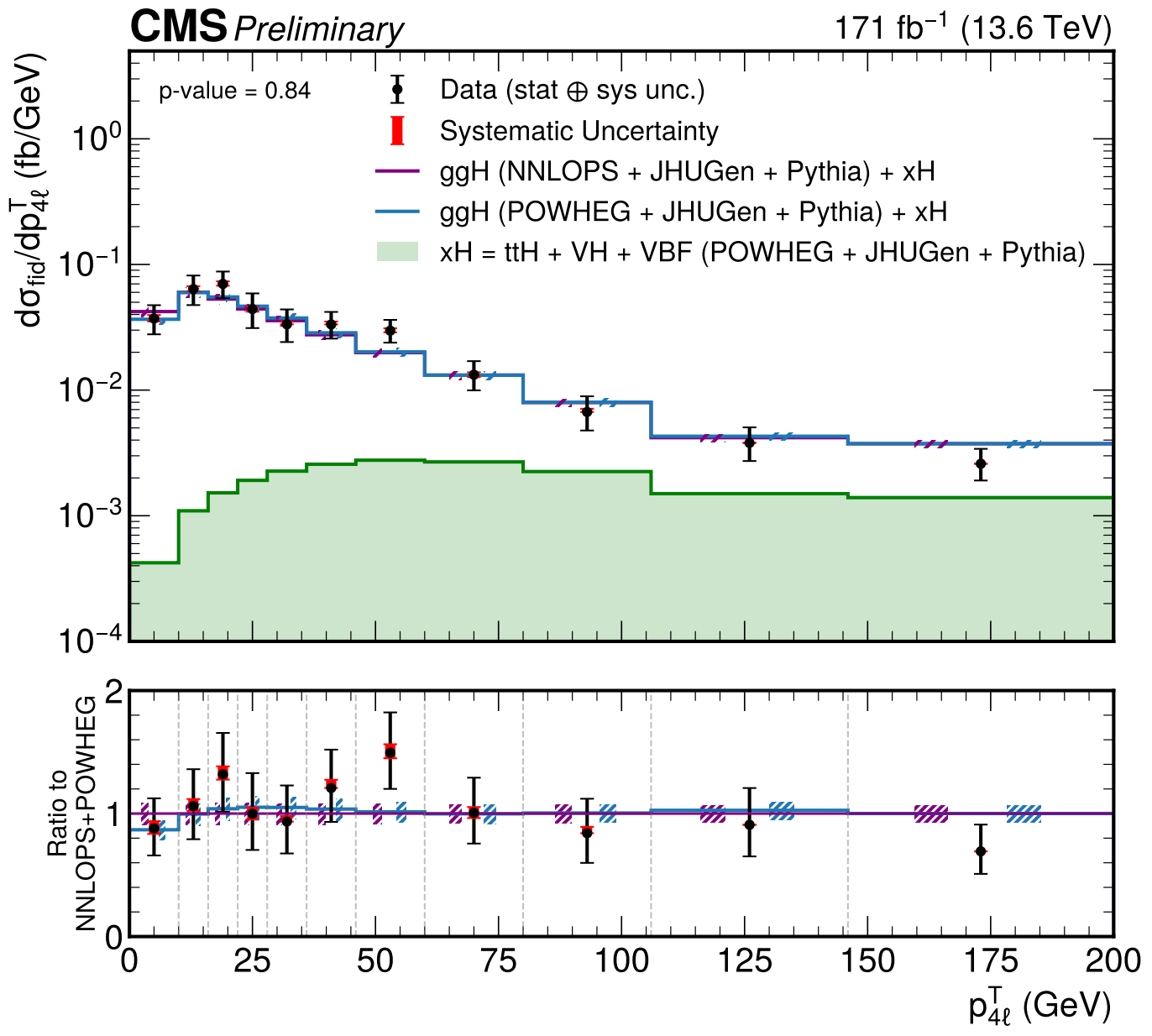
Above: Rate of production (differential cross section) of the Higgs boson as a function of its transverse momentum. The lower panel shows the ratio to Standard Model predictions, demonstrating good agreement between data and the predictions.
The measurements agree with the Standard Model predictions, and the increased precision enhances sensitivity to potential deviations that could hint at new physics beyond the Standard Model.
The transition from discovery to precision is now firmly underway, and with even more data expected in the coming years, the exploration of the Higgs boson is only accelerating. Each incremental improvement in measurement sharpens our picture of the laws of nature and deepens our insight into the universe at its most fundamental level.
Written by: Spencer Ellis and Martina Manoni, for the CMS Collaboration
Edited by: Muhammad Ansar Iqbal
Read more about these results:
-
CMS Physics Analysis Summary (HIG-25-015): "Measurements of inclusive and differential cross sections for Higgs boson production with decay to four leptons in proton-proton collisions at 13.6 TeV"
-
@CMSExperiment on social media: Bluesky - Facebook - Instagram - LinkedIn - TikTok - Twitter/X - YouTube