
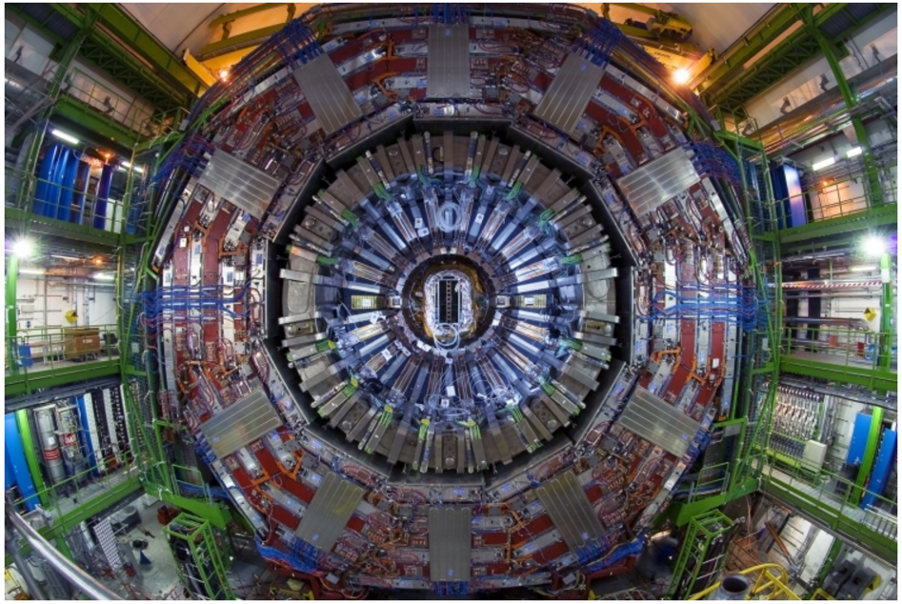
The CMS experiment presents the first measurement of ϒ mesons – bound states of a bottom quark-antiquark pair – in oxygen-oxygen and neon-neon collisions, and strongly indicates that their production is suppressed owing to quark-gluon plasma droplets formed in such light-ion collisions.
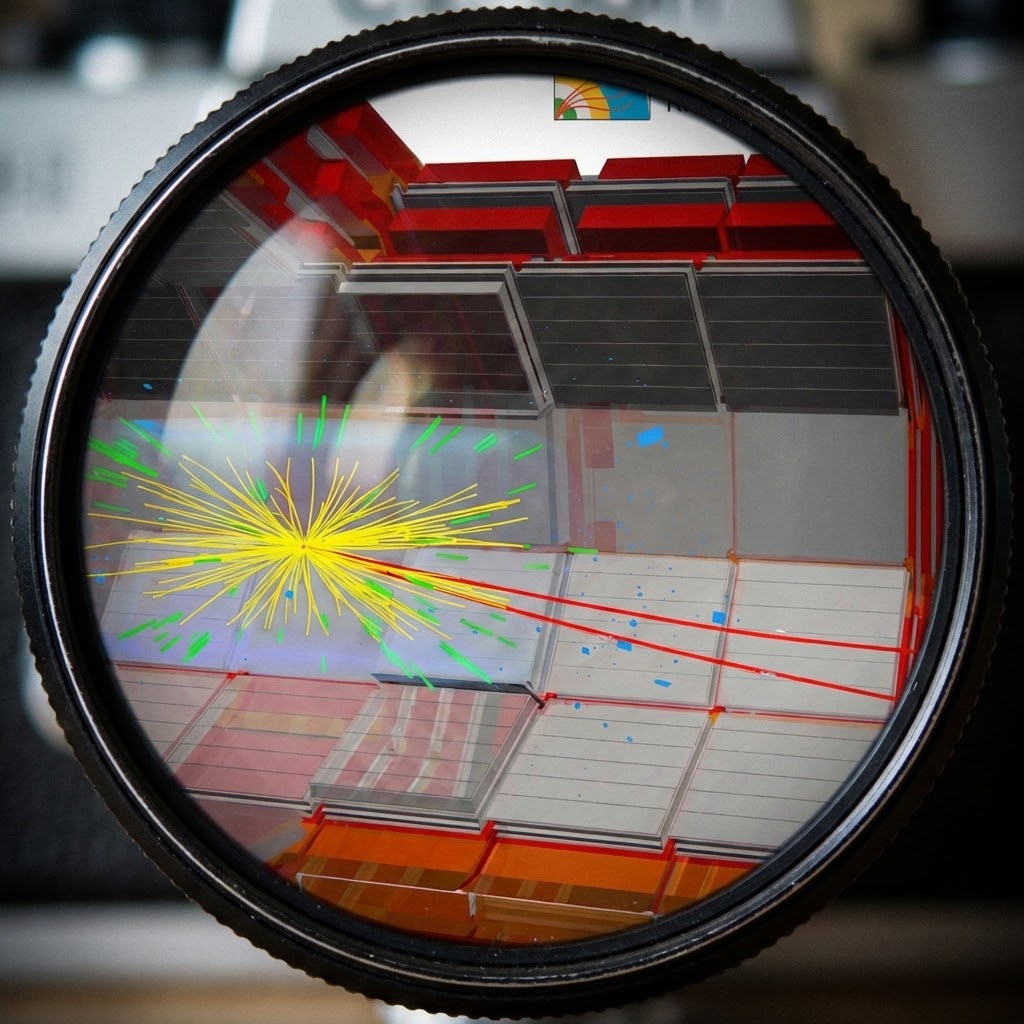
In collisions of nuclei at the LHC, a tiny fireball of quark-gluon plasma can form and disappear almost instantly. The plasma itself never reaches the detector. Instead, CMS observes particles produced after the collision, such as the muons shown above, which carry information about the conditions inside the short-lived medium.
This measurement tests whether collisions of light nuclei still create a medium strong enough to dissociate heavy quark-antiquark bound states. Think of three wax seals that melt at different temperatures in a fire. If the weakest seal disappears first while the strongest survives, the pattern reveals the intensity of the vanished fire. CMS uses three bottom quark-antiquark states, Υ(1S), Υ(2S), and Υ(3S), as those seals.
In July 2025, the LHC delivered oxygen-oxygen and neon-neon collisions for the first time. The data recorded by the CMS experiment during these light-ion runs at 5.36 TeV opened a new regime for this test. Proton-proton collision data at the same energy provide the baseline. By forming double ratios, i.e., the relative survival probabilities for the three states between light-ion and proton-proton collisions, many experimental uncertainties cancel and the effect of the medium becomes much clearer.
Experimentally, the Υ states are identified by their decay into pairs of oppositely charged muons, which CMS measures with high precision. Their invariant-mass spectrum reveals the Υ(1S), Υ(2S), and Υ(3S) peaks. The smaller the excited-state peaks become relative to the proton-proton reference, the stronger the evidence that the medium is breaking those states apart.
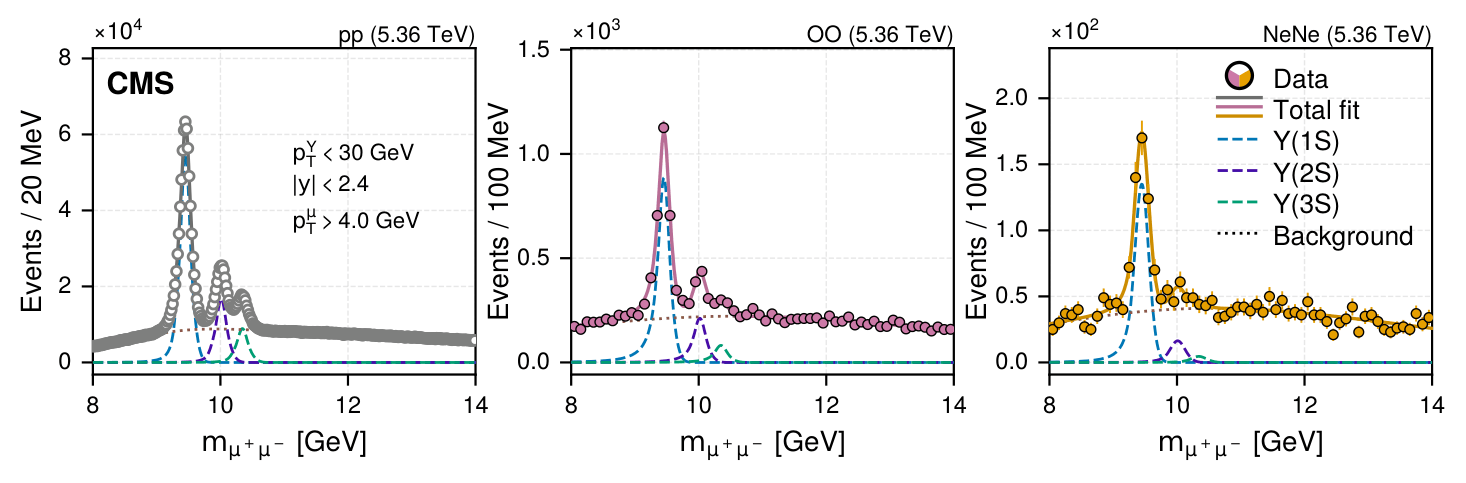
Above: Dimuon invariant-mass spectra in proton-proton, oxygen-oxygen, and neon-neon collisions. The excited Υ states are visibly reduced in the light-ion data.
The result is striking. Every measured double ratio lies below one. In oxygen-oxygen collisions, both Υ(2S) and Υ(3S) are suppressed relative to Υ(1S) with statistical significances above six standard deviations. In neon-neon collisions, the Υ(2S) suppression also exceeds six standard deviations. “For us, the most exciting part is the level of suppression and how persistent this pattern is across the measured phase space,” says Soohwan Lee, the researcher who led the light-ion analysis. The new oxygen-oxygen and neon-neon points extend sequential Υ suppression down to collisions involving only about ten participating nucleons on average.
The result also fits into a broader CMS picture built across collision systems: in a recent proton-lead measurement at 8.16 TeV, the Υ(2S)/Υ(1S) and Υ(3S)/Υ(1S) ratios were also found to decrease as events became busier, with the more weakly bound Υ(3S) showing the stronger reduction. “What makes this program particularly exciting is the opportunity to reveal how quarkonium suppression unfolds as collision environments become increasingly complex,” says Shirsendu Nanda, who led the proton-lead analysis.
Seen within this broader CMS nuclear program, the new light-ion results probe how the sequential suppression pattern evolves as we move from asymmetric small nuclear collisions to symmetric ion-ion systems that are still much smaller than lead-lead. Neither the proton-lead nor oxygen-oxygen/neon-neon data settle every interpretation on their own, but together they open a new experimental bridge between few-body and many-body QCD. Light-ion collisions are therefore no longer merely an intermediate step between proton–lead and lead–lead systems. Instead, they are emerging as a unique laboratory in which to investigate how collective QCD phenomena arise, and where the transition from isolated particle interactions to strongly interacting nuclear matter can be explored in a detailed and systematic way.
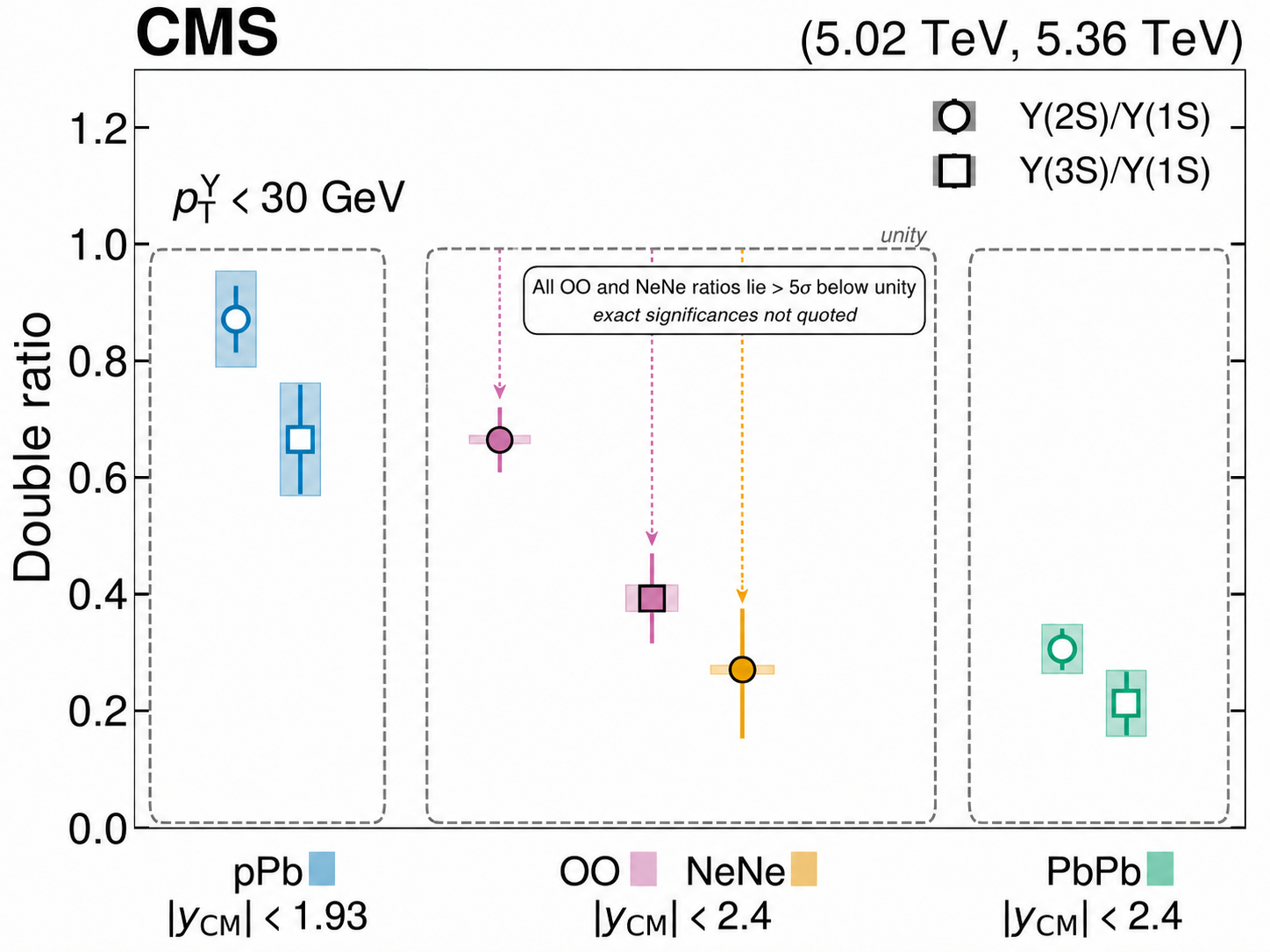
Above: CMS measurements of excited-state Υ suppression across proton-lead (pPb), oxygen-oxygen (OO), neon-neon (NeNe), and lead-lead (PbPb) collisions. Values below 1.0 show that the more weakly bound Υ states disappear more readily than Υ(1S).
Written by: Georgios Krintiras, for the CMS Collaboration
Edited by: Muhammad Ansar Iqbal
Read more about these results:
-
CMS Physics Analysis Summary (HIN-25-015): "Evidence for sequential Υ meson suppression in light ion collisions"
-
@CMSExperiment on social media: Bluesky - Facebook - Instagram - LinkedIn - TikTok - Twitter/X - YouTube