
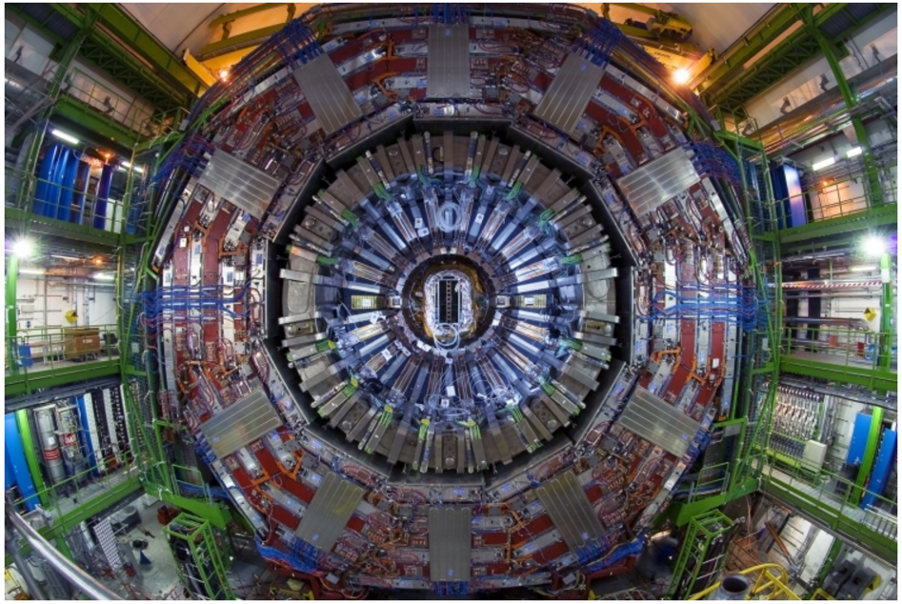
The CMS experiment reports the first observation of a “wake” created by a fast-moving parton in quark-gluon plasma.
Wake effect in quark-gluon plasma
When the LHC collides heavy nuclei, such as lead, at nearly the speed of light, it creates quark-gluon plasma (QGP) – a hot, dense fluid that filled the universe just after the Big Bang. In these collisions, energetic partons (quarks and gluons) emerge in the form of collimated sprays of particles called jets. As partons traverse the QGP, they lose energy and momentum to the medium, which, responds to this deposited energy. Among the expected manifestations of this response is a diffusion wake, similar to a disturbance formed behind a boat moving through water.
Understanding both the parton energy loss and the medium's response is essential for revealing the properties of the QGP. While the QGP’s impact on jets has been studied extensively for more than two decades, experimental searches for medium response signals have proven much more challenging. The expected signal is subtle and can easily be obscured by other effects. Recent CMS measurements of events containing a Z boson and a jet provided initial evidence of such a phenomenon; however the limited statistical significance prevented a definitive observation.
Wake search using dijet events
Building on recent theoretical advances, CMS has now searched for the wake signal using pairs of back-to-back jets produced in heavy-ion collisions (see figure below).
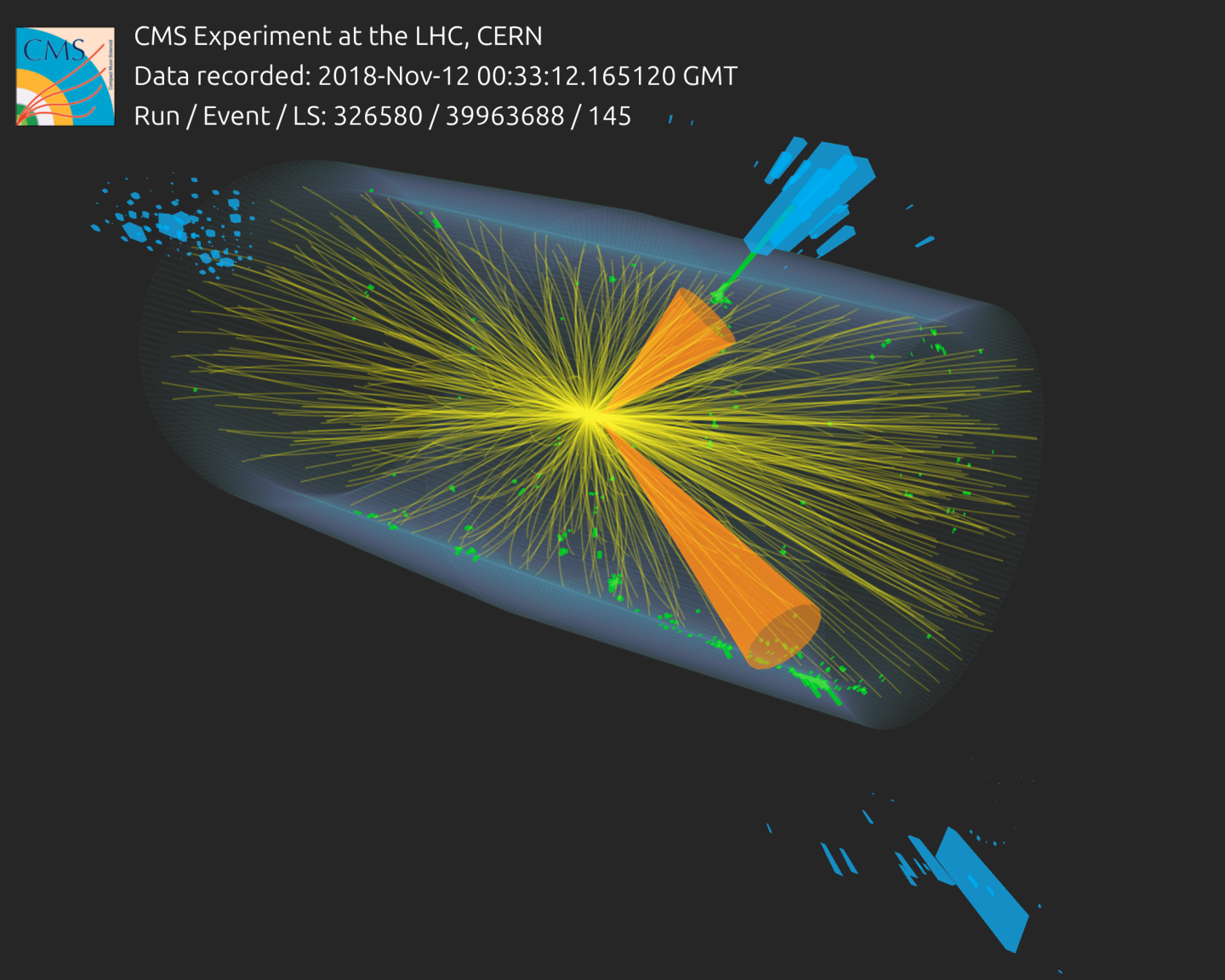
Above: Display of a lead-lead collision, which produced two back-to-back jets, recorded by the CMS experiment. The jets are indicated by the orange cones.
Because dijet events occur much more frequently than Z+jet events, they provide a powerful opportunity to search for the wake effect. By exploiting the back-to-back topology of the two jets and studying correlations between particles emitted around them, the diffusion wake signal can be disentangled from other jet-induced effects. The measurement reveals a clear depletion of particles behind the jet direction, particularly at the low momentum, consistent with expectations for a diffusion wake.
Observation of the wake effect
The figure below illustrates the size of the diffusion-wake-related depletion as a function of collision centrality. The centrality reflects the degree of overlap between the colliding lead nuclei, with 0% corresponding to complete overlap. Stronger wake signals are seen in the most central collisions, where the most QGP is formed. Results are shown for two transverse momentum ranges of the final-state particles: 1 < pT < 2 GeV (red circles) and 2 < pT < 4 GeV (blue squares).
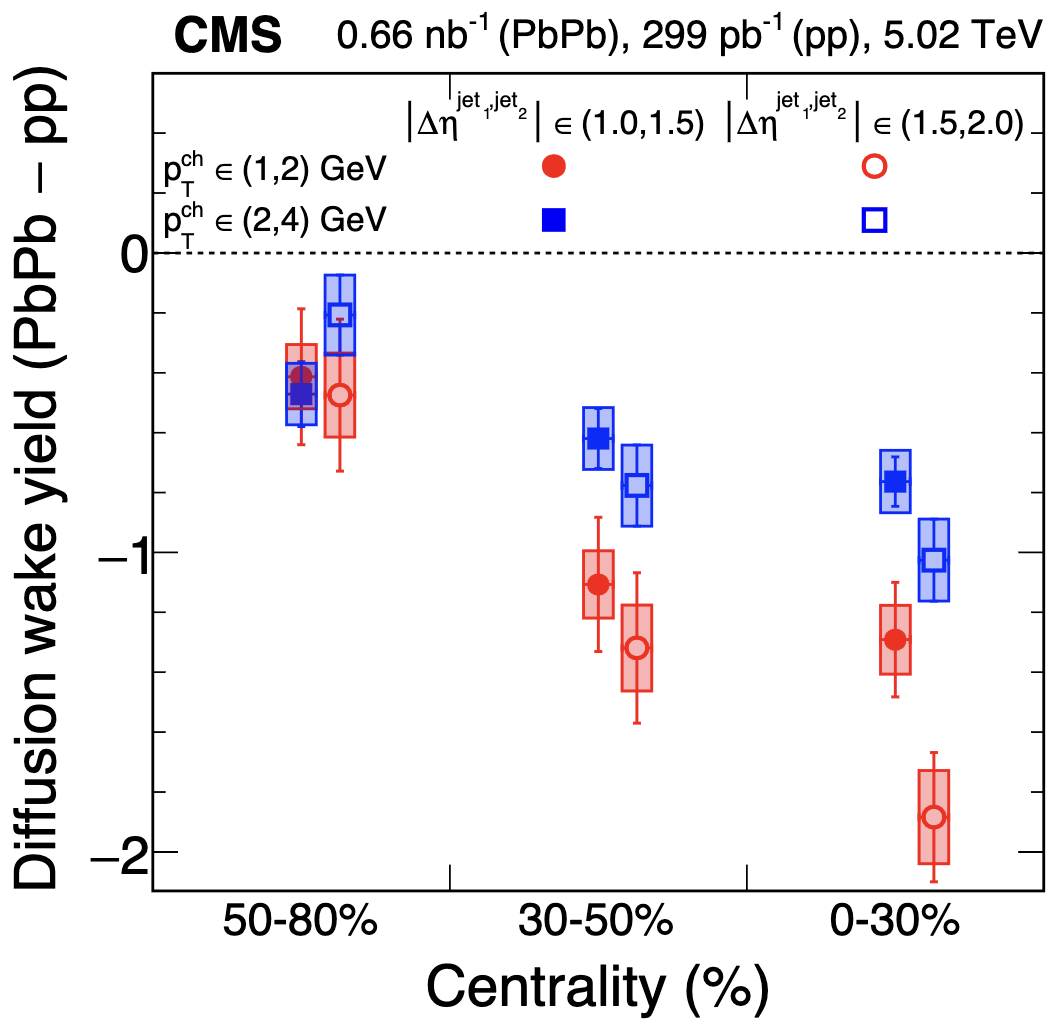
Above: Wake effect as a function of the overlap between the colliding nuclei. The amount of the wake effect is indicated by the separation of the points along the y-axis from a value of zero. The overlap is expressed in terms of centrality, with the overlap being larger for smaller centrality values.
The wake signal increases progressively from peripheral (50–80%) to central (0–30%) lead-lead collisions. In the most central collisions, the observed wake signal in the low-momentum particles (1 < pT < 2 GeV) deviates from zero (a no wake baseline) by more than five standard deviations.
This is the first direct observation of the wake effect in dijet events in nucleus–nucleus collisions.
CMS members from the University of Illinois Chicago (UIC), who led the dijet analysis, highlighted the significance of the discovery. “This observation is a culmination of a decades-long quest to observe the wake phenomenon; it has been predicted by theory over 20 years ago, but remained elusive in the experimental data,” says Prof. Olga Evdokimov of the UIC. “Observing and quantifying the QGP diffusion wake opens the door to the new precision characterization of the properties and dynamics of the quark-gluon plasma, and promises new insights into the evolution of the early universe,” said Raghunath Pradhan, a postdoctoral researcher at UIC and the lead analyzer of the study.
Written by: Raghunath Pradhan, for the CMS Collaboration
Edited by: Muhammad Ansar Iqbal
Read more about these results:
-
CMS Publication (HIN-25-012): "Observation of the jet diffusion wake using dijets in heavy ion collisions"
-
@CMSExperiment on social media: Bluesky - Facebook - Instagram - LinkedIn - TikTok - Twitter/X - YouTube