
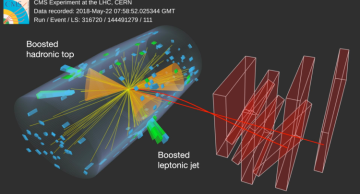
The CMS collaboration expands the search for supersymmetry by exploring a wide variety of final states with boosted particles, in a new analysis called “razor boost”.
Supersymmetry, or SUSY, which suggests that every known particle has a new…
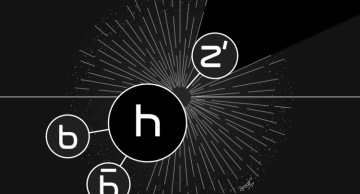
Remember the media buzz when we finally pinned down the Higgs boson in 2012? Turns out it might have a shadowy cousin – the dark Higgs – and CMS is chasing it down.
CMS scoured its entire Run 2 data set,138 fb–1 of proton-proton collisions at…
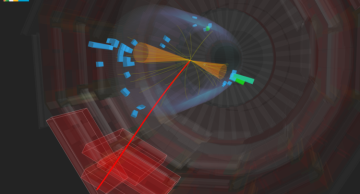
For the first time, the CMS experiment measures the production of single top quarks in a mode called the “t-channel” at 5.02 TeV, reporting results aligned with the standard model expectations.
In the quest to probe the fundamental laws of…
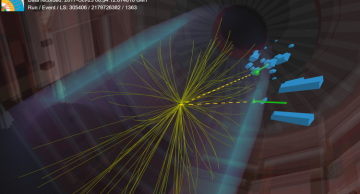
By observing decays of Higgs bosons into pairs of photons, the CMS experiment probes anomalous interactions, including those between Higgs bosons and W/Z bosons or gluons when all particles are replaced with their antiparticles and space is…
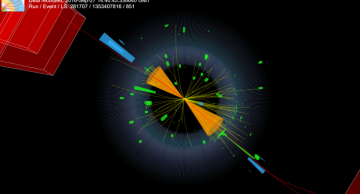
The CMS experiment achieves the most precise determination of the strength of the strong nuclear force using the rates of production of jets at several centre-of-mass energies.
The strengths of the fundamental interactions in Nature drive the…
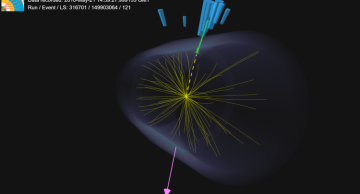
By studying events with only a single energetic photon, the CMS experiment places some of the most stringent constraints to date on dark matter models and theories predicting extra dimensions of space.
One way to explore physics beyond the…
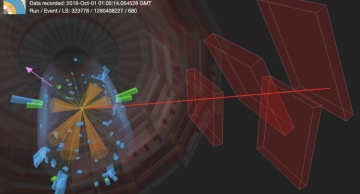
The CMS experiment presents the first-ever search for a Higgs boson decaying to charm quarks when the Higgs boson is produced along with two top quarks.
The Higgs boson plays a central role in our understanding of the fundamental forces of…
For the first time, the CMS experiment has employed physics-informed machine learning to observe whether the laws of physics still hold true when top quarks and Z bosons are replaced with their antiparticles and space is reflected.
We know…
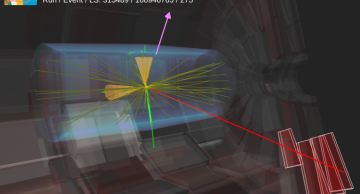
An excess in data hints at the existence of a top quark-antiquark quasi-bound state, called “toponium”.
The CMS collaboration has reported an excess in interactions involving top quark pairs. The results are consistent with a pair of top quark and…
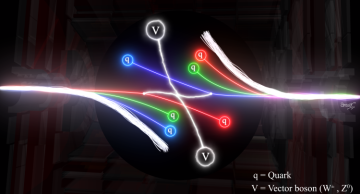
The CMS experiment performs a combined measurement of the scattering of W and Z bosons in the several possible final states, improving over the precision of each individual result.
When the Large Hadron Collider started taking data in 2008,…
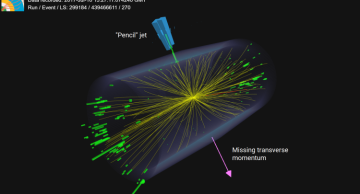
The CMS experiment conducts the first search for dark matter particles produced in association with an energetic narrow jet—the pencil jet.
Dark matter remains one of physics’ greatest mysteries. Despite making up about 27% of the universe’s…
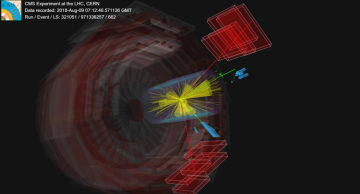
In a recent measurement, the CMS experiment confirms a slight but persistent disagreement between the simulated and the observed rates of events in which a top quark pair is produced accompanied by a W boson.
One of the goals of the CMS…