
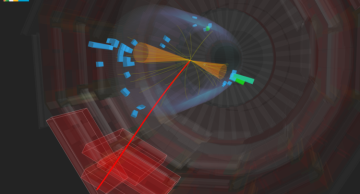
For the first time, the CMS experiment measures the production of single top quarks in a mode called the “t-channel” at 5.02 TeV, reporting results aligned with the standard model expectations.
In the quest to probe the fundamental laws of…
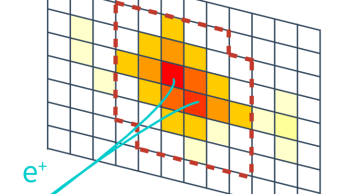
The CMS collaboration has developed a new technique to distinguish electron-positron pairs travelling so closely together that we see them as a single cluster of deposited energy.
Identifying electrons is one of the greatest strengths of the CMS…
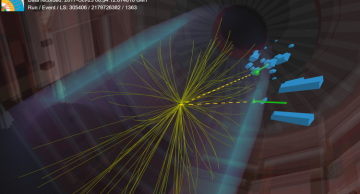
By observing decays of Higgs bosons into pairs of photons, the CMS experiment probes anomalous interactions, including those between Higgs bosons and W/Z bosons or gluons when all particles are replaced with their antiparticles and space is…
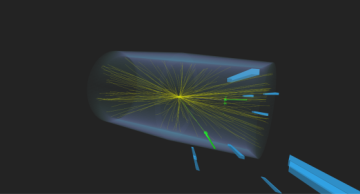
The CMS experiment sets limits for BSM particles down to tens-of-MeV aided by machine learning techniques.
Axion-like particles (ALPs) are hypothetical light-weight neutral bosons that could solve deep mysteries in physics, from the strong CP…

The CMS experiment employs a new machine-learning algorithm to improve the reconstruction of invisible particles.
How can one measure particles that escape the detector without interaction? This is the challenge for a key fundamental particle, the…
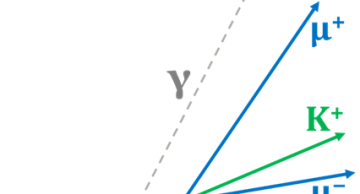
For the first time ever, the excited states of three beauty mesons are fully reconstructed and their masses are measured directly, using data from the CMS experiment.
The existence of the excited B meson states, B*+, B*0, and B*0s(also known as…
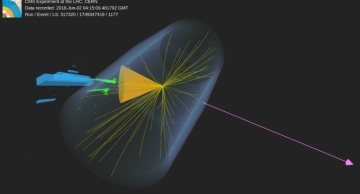
The CMS Collaboration hunts for Higgs bosons recoiling against dark matter particles
Dark matter is one of the most perplexing mysteries of our universe, accounting for roughly 27% of its total energy. Dark matter does not emit, absorb, or reflect…
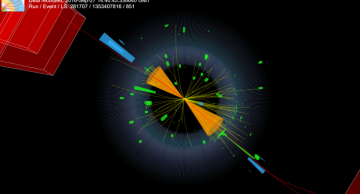
The CMS experiment achieves the most precise determination of the strength of the strong nuclear force using the rates of production of jets at several centre-of-mass energies.
The strengths of the fundamental interactions in Nature drive the…
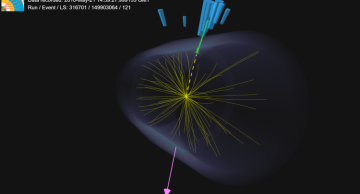
By studying events with only a single energetic photon, the CMS experiment places some of the most stringent constraints to date on dark matter models and theories predicting extra dimensions of space.
One way to explore physics beyond the…
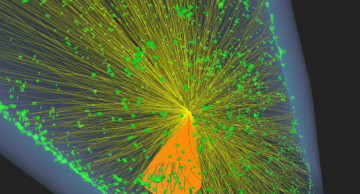
CMS explores the early stages of jet evolution in heavy-ion collisions
When heavy ions such as lead (Pb) collide in the LHC, a new state of matter called the quark-gluon plasma (QGP) is formed. The QGP is a high-temperature near-perfect liquid…
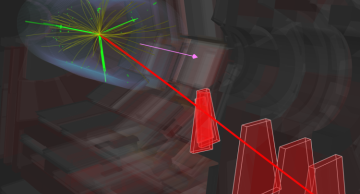
CMS presents the most precise measurement of WWZ production to date by combining Run 2 data with more recent Run 3 data.
The electroweak interaction provides a unified description of the electromagnetic and weak forces, but this symmetry is broken…
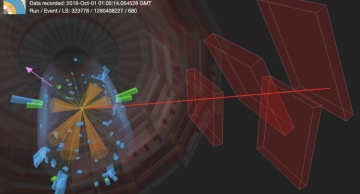
The CMS experiment presents the first-ever search for a Higgs boson decaying to charm quarks when the Higgs boson is produced along with two top quarks.
The Higgs boson plays a central role in our understanding of the fundamental forces of…