
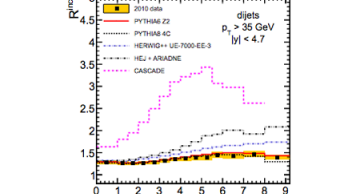
A study of dijet production in proton-proton collisions was performed at √s = 7 TeV for jets with pT > 35 GeV and |y| < 4.7[1] using data collected with the CMS detector at the LHC in 2010. Events with at least one pair of jets are denoted as…
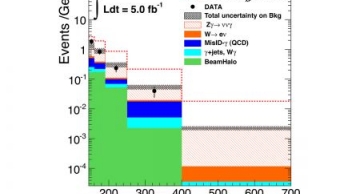
Results are presented from a search for new physics in which the final state contains a photon (γ) and missing transverse energy (MET). The data correspond to an integrated luminosity of 5.0 fb−1 (inverse femtobarns) collected in pp collisions at √s…

The LHC provides CMS with millions of collisions each second, and a wealth of physics data is obtained from the proton-proton interactions. In order to record all these data for analyses, all CMS sub-detectors have to be performing optimally. If you…
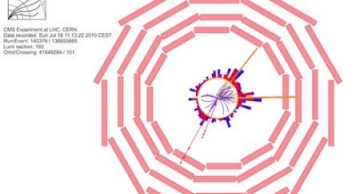
CMS has presented a rich variety of results at the Electroweak Interactions and Unified Theories sessions of the Rencontres de Moriond conference in La Thuile, Italy. Links to the Physics Analysis Summaries (PAS) from CMS made public in the last…
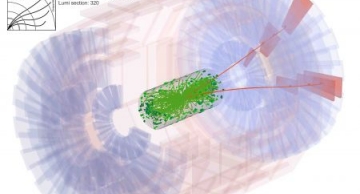
At a CERN seminar today, CMS presented results for the search for new physics in the decay of Bs and B0 mesons to two muons, taking into account all of the 4.9 fb−1 of data collected in 2011. The results — upper limits of 7.7 x 10⁻⁹ (Bs) and 1.8 x…
Spot the difference
So how did the universe evolve into this very asymmetric state, dominated by matter, if the underlying forces can barely tell the difference between the two? One possible explanation is that there exists yet another, undiscovered…
Antimatter detectives
The antimatter is missing – not from CERN, but from the Universe! At least that is what we can deduce so far from careful examination of the evidence. For each basic particle of matter, there exists an antiparticle with the…
Probing the Plasma
Lead nuclei consist of large numbers of protons and neutrons, both made up of quarks. When the nuclei collide, a range of particles will be produced, some of which are expected to behave differently if a QGP is produced and such…
Colliding heavy nuclei
Clues to the early Universe
The Universe has changed a great deal in the 13.7 billion years since the Big Bang, but the basic building blocks of everything from microbes to galaxies were signed, sealed and delivered in the…
Superstring theory is elegant but speculative and throws up a number of possible experimental outcomes, some more likely than others.
One option would be to find evidence of another host of particles that can only exist if there are more dimensions…
String theory and extra dimensions
Loose ends
Will the string tie the Standard package? Hot on the heels of the Standard Model, some physicists are working to support an idea called string theory. This attempts to tie up the loose ends in the…
Evidence from the depths of the Universe has ruled out a number of models for what the mysterious dark matter might be, but one candidate that fits so far is the lightest supersymmetric particle (LSP) otherwise known as the “neutralino”, the…