
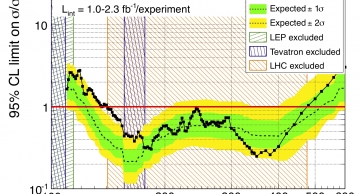
Perhaps the most anticipated result of the LHC involves the search for the Higgs boson, the only particle predicted by the Standard Model (SM) that has not yet been seen by experiments. The Higgs boson helps explain how elementary particles acquire…
Grab a can of soda, shake it thoroughly, and open it up. What do you get? It’s an explosion of fizz. A similar phenomenon in the subatomic world might help us probe the nature of fundamental particles.
Scientists have spent centuries searching for…
Read the paper: EXO-11-005
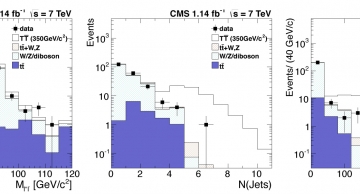
In this Letter, CMS describes a search for a kind of fourth-generation T quark with charge 2/3. The search for T-antiT pairs was performed in events that had a pair of oppositely charged leptons (l+l−) as well as an…
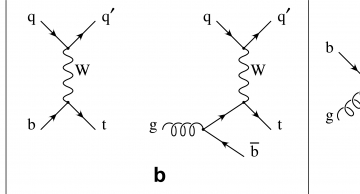
The Top quark is the heaviest of the six quarks of the Standard Model and was discovered only 16 years ago by the Tevatron experiments at Fermilab. In addition to the usual production of Top-AntiTop pairs in accordance with quantum chromodynamics (…
Read the paper: SUS-11-003
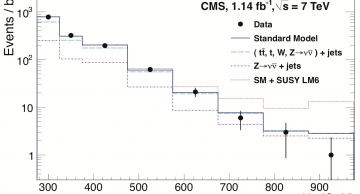
The analysis shows no excess of events over the Standard Model expectations. As a result, exclusion limits were placed on searches for squarks and gluinos in the Constrained Minimal Supersymmetric extension of the Standard…
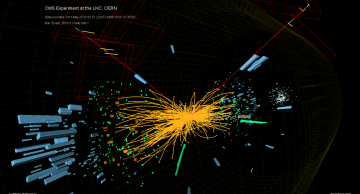
The Higgs boson is the only particle predicted by the Standard Model that has not yet been seen by experiments. It helps explain how elementary particles acquire mass. If the Higgs boson exists it will be produced in proton-proton collisions at the…
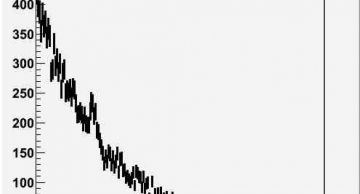
A dangerous beast is hiding in today’s searches for the rare signs of new physics — or even “old” physics, such as the Higgs boson — at the Large Hadron Collider. It is called “Look-Elsewhere Effect”, LEE for insiders. What is it, and why…
Read the paper: TOP-11-003
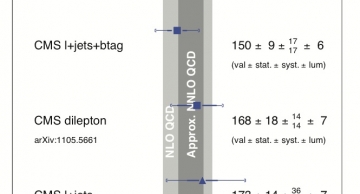
The measured production rates of Top-antiTop pairs, where one lepton and four jets of particles is observed in the final state, show good agreement with Quantum Chromodynamics (QCD), the theory of the strong interaction.…
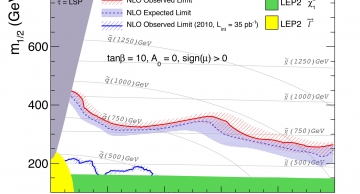
High-energy collisions with final states that include leptons (electrons, muons or taus) have played major roles in the history of physics. Several particles – such as J/ψ, W, and Z – as well as productions of pairs of Top quarks were discovered in…

Once more a reminder of the Lepton-Photon approvals, which will start in less than a week from now.
The INDICO agenda, now with rooms and EVO booking info, can be found here: https://indico.cern.ch/conferenceDisplay.py?confId=149749
At the top of…
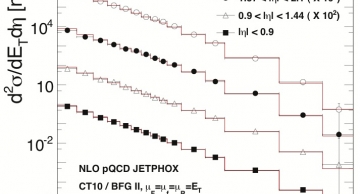
Read the paper: QCD-10-037
This paper extends CMS’s previous measurements of the production rates of isolated prompt photons. The production rates agree with the predictions of perturbative Quantum Chromodynamics (pQCD), although, at low transverse…
Read the paper: QCD-10-037
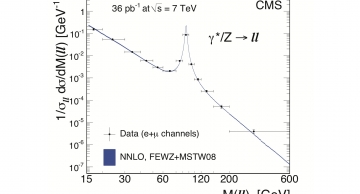
The measured Drell-Yan production rates, normalised to the production rates in the Z-boson region, show good agreement with the theoretical predictions.
The Drell-Yan process occurs when a quark from one of the colliding…