

All of the atoms in our bodies are made of electrons, protons and neutrons, and the protons and neutrons can be further broken down into quarks. Fundamentally, then, we are made of only two types of particles: electrons and quarks. But what do these…
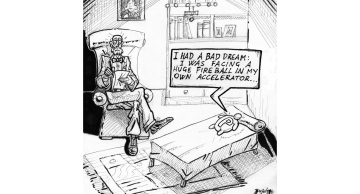
Our best understanding of the early Universe tells us that a dense medium, known as the quark-gluon plasma (QGP), existed in the first microseconds after the big bang. These early-Universe conditions can be mimicked in particle colliders by smashing…
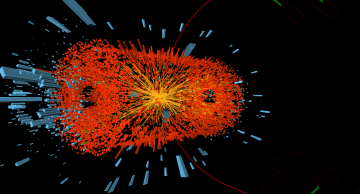
The Quark Matter 2012 conference, held in Washington DC from 13-18 August 2012, brings together experimental and theoretical experts in the area of heavy-ion physics. This week, the CMS collaboration is presenting many exciting new results using…
31 July 2012, CERN
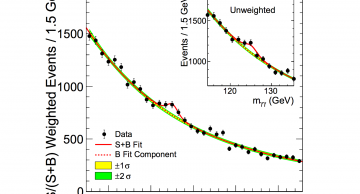
Today CMS submitted for publication, in the Physics Letters B journal, a paper entitled "Observation of a new boson at a mass of 125 GeV with the CMS experiment at the LHC". The abstract for the paper [get PDF here] reads:…
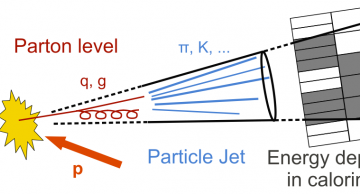
Jets are the experimental signatures of quarks and gluons produced in high-energy processes such as head-on proton-proton collisions. As quarks and gluons have a net colour charge and cannot exist freely due to colour-confinement, they are not…
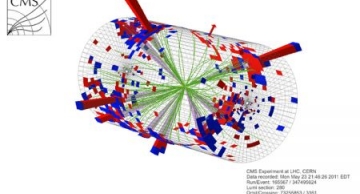
The search for microscopic black holes at the LHC is motivated by the hierarchy problem — the huge observed difference between the strengths of the electroweak and gravitational forces. The ADD model (Arkani-Hamed, Dimopoulos, and Dvali) offers an…
On request of the FSQ PAG a run with very low pile-up (PU = 0.037) was taken for minimum bias and underlying event studies. Trigger information was exchanged between CMS and TOTEM and a common dataset has been obtained.
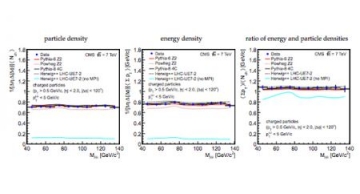
A measurement of the underlying event (UE) activity in proton-proton collisions at a centre-of-mass energy of 7 TeV is performed using Drell-Yan events in a data sample corresponding to an integrated luminosity of 2.2 fb−1 (inverse femtobarns),…
ol.setstyle {list-style-type:arabic-lower;}
p.setheight {line-height: 170%;
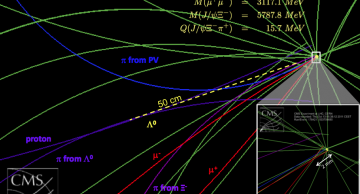
The CMS experiment has submitted a paper for publication describing the first observation of a new, excited bottom (or beauty) baryon known as the Ξ*b0, with a…
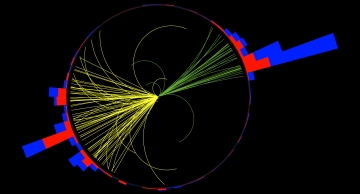
A search is presented for a massive particle, generically referred to as a Z′, decaying into a t-tbar pair. The search focuses on Z′ resonances that are sufficiently massive to produce highly Lorentz-boosted top quarks, which yield collimated decay…
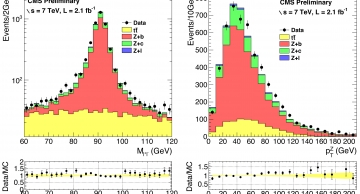
The production of b jets in association with a Z/γ* boson is studied using proton-proton collisions delivered by the LHC at a centre-of-mass energy of 7 TeV and recorded by the CMS detector. The inclusive production rates for Z/γ* + b-jet is…
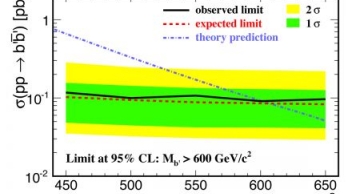
Results are presented from a search for heavy bottom-like quarks, produced in pairs in pp collisions at √s = 7 TeV, undertaken with the CMS experiment at the LHC. The b′ quarks are assumed to decay exclusively to a top quark and a W boson (tW). The…