Category: Physics

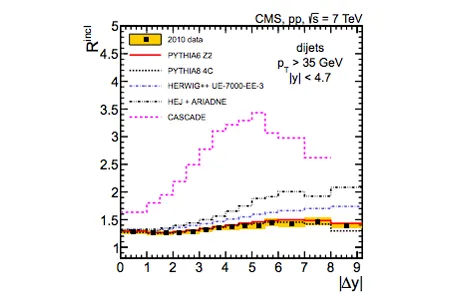
  • Ratios of dijet production cross sections as a function of the absolute difference in rapidity between jets in proton-proton collisions at sqrt(s) = 7 TeV

    Ratios of dijet production cross sections as a function of the absolute difference in rapidity between jets in proton-proton collisions at sqrt(s) = 7 TeV

    A study of dijet production in proton-proton collisions was performed at √s = 7 TeV for jets with pT > 35 GeV and |y| < 4.7[1] using data collected with the CMS detector at the LHC in 2010. Events with at least one pair of jets are denoted as “inclusive”, while events with exactly one…

    Explore →

  • New “Physics Performance and Dataset” Group at CMS

    New “Physics Performance and Dataset” Group at CMS

    The LHC provides CMS with millions of collisions each second, and a wealth of physics data is obtained from the proton-proton interactions.

    Explore →

  • Physics Analysis Summaries for Moriond Conference  (Electroweak)

    Physics Analysis Summaries for Moriond Conference (Electroweak)

    CMS has presented a rich variety of results at the Electroweak Interactions and Unified Theories sessions of the Rencontres de Moriond conference in La Thuile, Italy.

    Explore →

  • Search for rare decay of neutral B mesons to two muons

    Search for rare decay of neutral B mesons to two muons

    At a CERN seminar today, CMS presented results for the search for new physics in the decay of Bs and B0 mesons to two muons, taking into account all of the 4.9 fb−1 of data collected in 2011. The results — upper limits of 7.7 x 10⁻⁹ (Bs) and 1.8 x 10⁻⁹ (B0) at 95%…

    Explore →

  • Antimatter in CMS

    Spot the difference So how did the universe evolve into this very asymmetric state, dominated by matter, if the underlying forces can barely tell the difference between the two?

    Explore →

  • What and where is Antimatter?

    Antimatter detectives The antimatter is missing – not from CERN, but from the Universe!

    Explore →

  • Heavy Ions in CMS

    Probing the Plasma Lead nuclei consist of large numbers of protons and neutrons, both made up of quarks.

    Explore →

  • How did Matter form?

    Colliding heavy nuclei Clues to the early Universe The Universe has changed a great deal in the 13.7 billion years since the Big Bang, but the basic building blocks of everything from microbes to galaxies were signed, sealed and delivered in the first few millionths of a second.

    Explore →

  • Detecting extra dimensions

    Superstring theory is elegant but speculative and throws up a number of possible experimental outcomes, some more likely than others.

    Explore →

  • Do we really live in only three dimensions?

    String theory and extra dimensions Loose ends Will the string tie the Standard package?

    Explore →