
The CMS experiment performs the first collider search for “inelastic dark matter” in the case where dark-matter particles travel a measurable distance before decaying into a pair of low-momentum electrons.
Most of the matter in the universe is invisible. Known as dark matter, it outweighs ordinary matter – which is made up of Standard Model particles – by a factor of five. Yet, its true nature remains unknown. Many theories propose new particles that could explain it, and experiments around the world are testing these ideas. At CERN, the LHC explores a wide range of possible signatures that could reveal dark matter potentially produced in high energy proton–proton collisions.
The CMS experiment has recently conducted the first collider search targeting an unconventional electron signature that could be produced by inelastic dark matter, a proposed theory of dark matter that may explain why no existing experiment has been able to observe dark matter directly. In this scenario, a dark-matter particle can be produced along with a slightly excited partner state, which can travel a measurable distance before decaying, producing two low-momentum electrons.
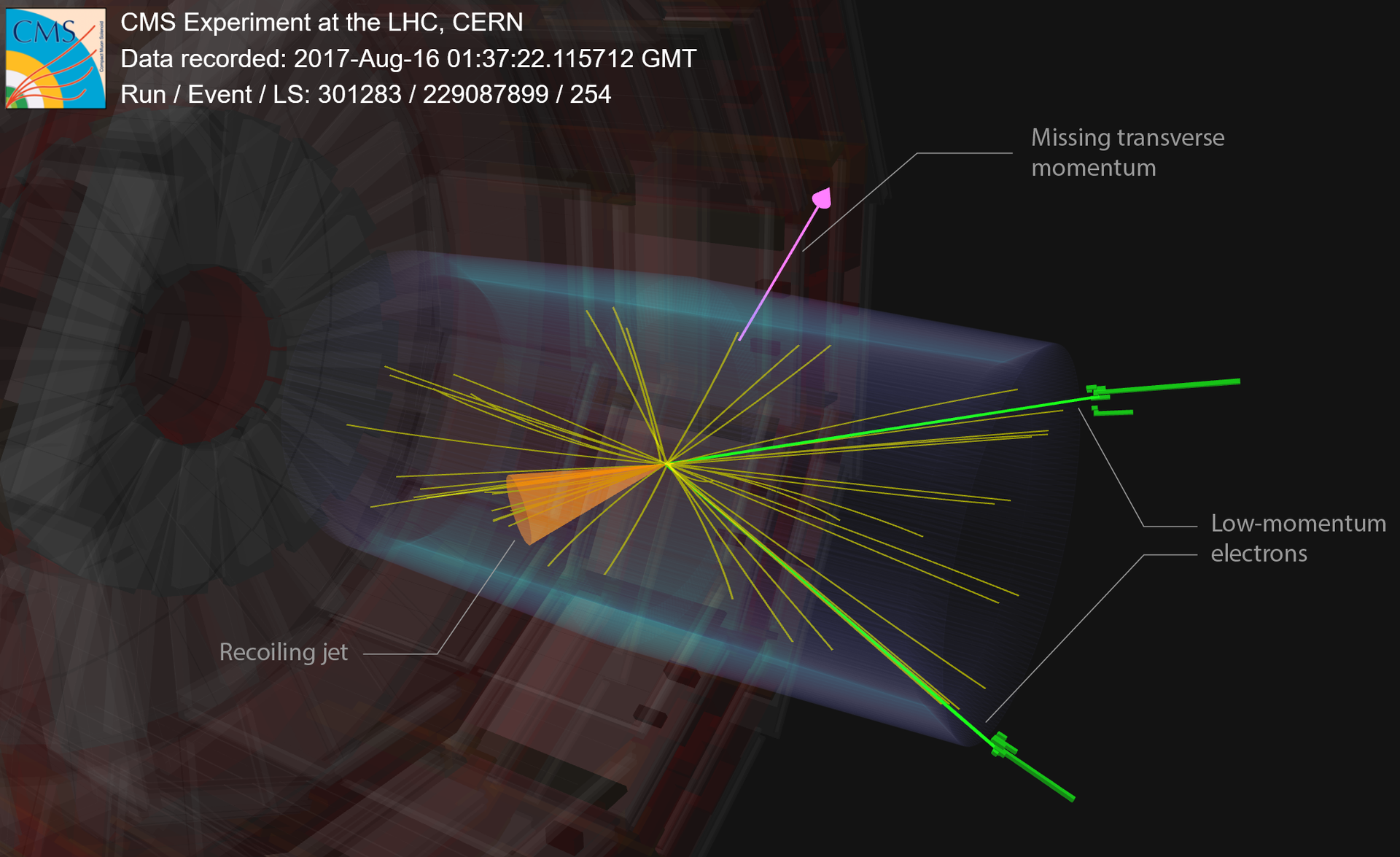
"It's entirely possible that the universe is full of this kind of dark matter, but it just doesn't have enough energy to interact with our experiments," explains Bryan Cardwell, postdoc at the University of Virginia. "This makes the search for inelastic dark matter at the LHC particularly exciting – producing it directly in LHC collisions may give us a chance to see something that would otherwise be invisible." A distinctive feature of this search is its unusual collider signature involving a pair of low-momentum electrons close to one another but far away from the main collision point, accompanied by missing transverse momentum carried away by invisible particles.
To capture such low-momentum, long-lived signatures, which are particularly challenging to identify, the analysis deploys a special method to reconstruct low-momentum electrons (“low-pT electrons”). Originally developed for studies of B hadron decays, the low-pT electron algorithm primarily relies on the tracking information with dedicated machine learning for reconstruction, rather than energy deposits in the electromagnetic calorimeter, unlike the standard electron reconstruction approach. It can identify electrons with transverse momenta as low as 1 GeV – in contrast, the standard algorithm is efficient only for electrons above 5 GeV – even in collisions reaching TeV energies, as well as those with macroscopic displacement from the main collision point, recovering events that would otherwise be missed by the search.
“One of the interesting aspects of this search is that a reconstruction technique originally designed for a different physics context turns out to be very powerful for this dark-matter signature,” says Kyungmin Park, a doctoral student at Carnegie Mellon University. “It allows us to identify low-momentum electrons that originate far from the collision point – a particularly challenging combination to reconstruct in the detector – and search for this signature that would otherwise be inaccessible.”
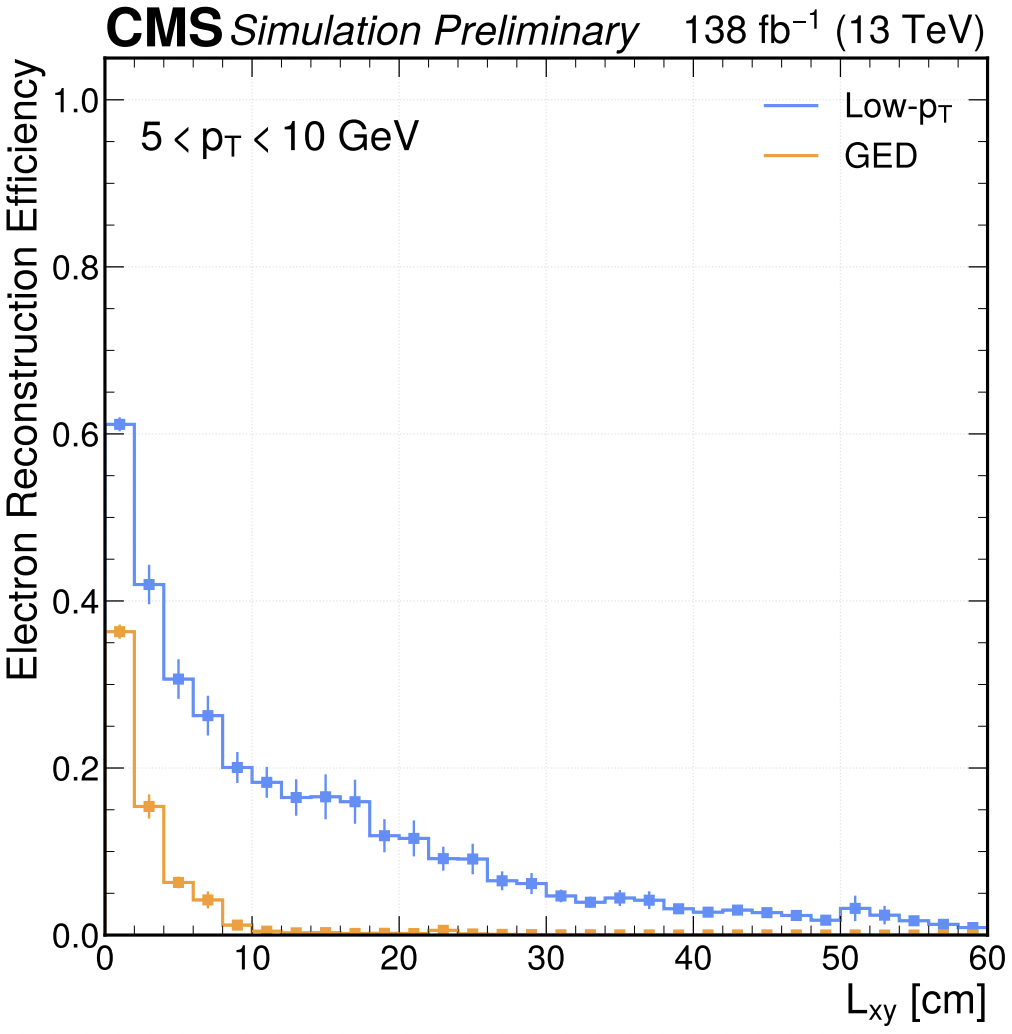
Above: Efficiency of reconstructing electrons using the low-pT algorithm (blue) compared to the standard (GED) algorithm (orange).
Machine-learning techniques are then used to distinguish potential signal events from Standard Model backgrounds by identifying the unique event pattern of two close-by electrons emerging away from the collision point, further improving the sensitivity of the search. Very few background events are expected to survive the selections targeting such unique topology, as illustrated in the event display.
No significant excess of events above expectations from known Standard Model processes is observed in the data. The analysis sets the first collider limits on inelastic dark matter in the electron channel, constraining scenarios with small mass differences and measurable displacements.
Building on an earlier similar CMS search using muons, this study expands the exploration of inelastic dark matter into regions that are uniquely accessible at colliders and may evade detection by other experiments. With the larger dataset collected by CMS during Run 3, future searches will be able to probe even lower dark matter masses and larger displacement scenarios in both the electron and muon channels, pushing further into this unconventional territory of dark matter exploration.
Written by: Kyungmin Park, for the CMS Collaboration
Edited by: Muhammad Ansar Iqbal
Read more about these results:
-
CMS Physics Analysis Summary (EXO-24-036): "Search for inelastic dark matter with low-momentum displaced electrons in proton-proton collisions at √s= 13 TeV"
-
@CMSExperiment on social media: Bluesky - Facebook - Instagram - LinkedIn - TikTok - Twitter/X - YouTube