Images of collisions
- Read more about Images of collisions
- Log in to post comments
CMS physics in an easily accessible format for all ages and audiences
Curious minds might wonder why the LHC, which successfully ran at 7 TeV during the pp run of 2010 began the new year with proton collisions at a significantly less energy of 2.76 TeV.
If you buy just about any LHC physicist a beer, and talk for a while, eventually you'll learn that he or she lives for the day when we make the next great discovery at this amazing machine.
Christophe Delaere, from the Université catholique de Louvain in Belgium, has been with CMS for five years. Christophe works on the Tracker, the sub-detector that traces the path of charged particles that are formed in collisions at the LHC.
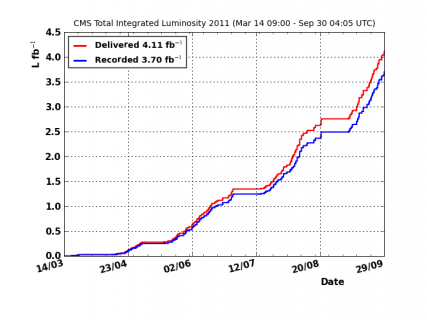
Record fill for CMS: recorded 35.5 pb-1 ("inverse picobarns") of collisions - almost as much as we recorded in the whole of 2010!
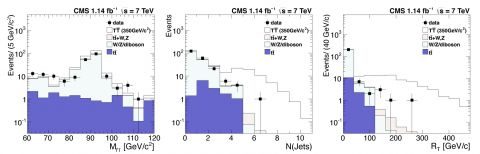
The t t-bar production cross section and top quark mass are measured in proton-proton collisions at sqrt(s) = 7 TeV in a data sample corresponding to an integrated luminosity of 36 inverse picobarns collected by the CMS experiment.
The CMS collaboration is presenting its latest results this week at the annual Quark Matter conference, held this year in Annecy, France.
The CMS experiment has made several unique measurements using data from LHC collisions of lead nuclei (PbPb, November 2010) at centre-of-mass energies of 2.76 TeV per nucleon pair.
In our Universe today, quarks are always bound together by gluons to form "composite" particles such as protons and neutrons. The Quark-Gluon Plasma, or QGP, often described as a soup-like medium, is a hot, dense state in which these quarks and gluons exist freely, unbound.