ATLAS and CMS combine summer '11 search limits on the Standard Model Higgs

By combining their data ATLAS and CMS increase their sensitivity in the Higgs boson search

By combining their data ATLAS and CMS increase their sensitivity in the Higgs boson search

At 17:00 on Sunday 30th October the LHC dumped the last proton beams
for the year to start the machine development period
and to prepare for heavy ion running. This means that we have
come to the end of proton operation for 2011.

Grab a can of soda, shake it thoroughly, and open it up. What do you get? It’s an explosion of fizz. A similar phenomenon in the subatomic world might help us probe the nature of fundamental particles.

The LHC has now delivered 5 inverse femtobarns (fb−1) of data in 2011, of which CMS has collected 4.53 fb−1.

This year, for the first time, the winners of the Italian Physics, Mathematics and Informatics Olympiads received an unforgettable reward from the Italian Ministry of Education, University and Research (MIUR): a trip to CERN.

You have to be curious and creative to work for a project like CMS. Without these qualities, it would be impossible to build an instrument of its complexity. The CMS detector is a marvellous instrument at the forefront of technology and will open windows into 21st century science.
On Friday 7th October the LHC delivered, for the first time in the history of High Energy Physics, proton-proton collisions at the design frequency of 40 MHz, with bunches of protons colliding every 25 nanoseconds (ns), doubling the frequency achieved so far.
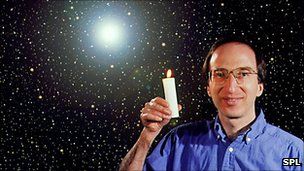
Three researchers behind the discovery that our Universe's expansion is accelerating have been awarded this year's Nobel prize for physics. Saul Perlmutter and Adam Riess of the US and Brian Schmidt of Australia will divide the prize. [...]
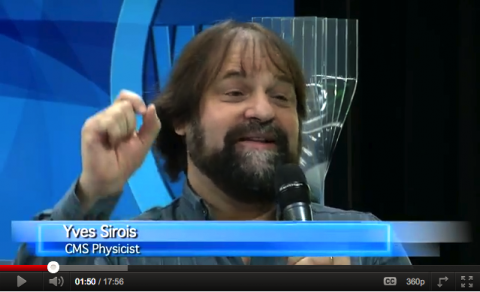
Watch the very first TV episode of "What's new @ CERN" featuring CMS physicist Yves Sirois, John Ellis and other physicists talking about the Higgs Boson, the Standard Model, Supersymmetry and neutrinos. "What's new @ CERN" is a new monthly outreach TV programme produced by CERN.
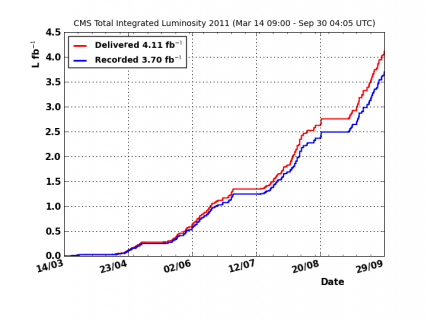
The LHC has now delivered over 4 inverse femtobarns (fb−1) of data in 2011, of which CMS has collected 3.7 fb−1.