Search for rare production of vector boson pairs

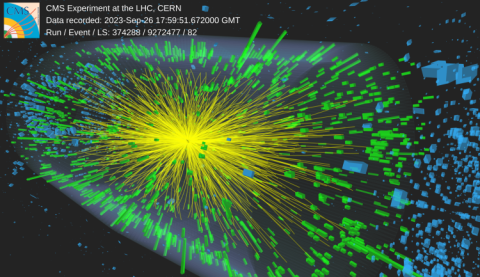
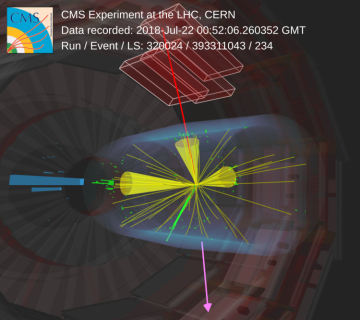
Vector boson (W, Z) scattering process is a purely weak process which have been studied here to investigate interesting characteristics of the standard model and to test new physics scenarios that have a sizable indirect impact on the measurable quantities. This analysis looks for production of two opposite sign W bosons accompanied by a pair of forward-backward jets with large mass and wide separation. In addition there is missing energy in the event due to two neutrinos produced with the muons. Since the rate of this process in standard model is extremely low, using machine learning techniques signal-to-background ratio has been increased considerably allowing observation of the process with good confidence. Nothing usual has been found.

In a detector far, far away: searching for elusive long-lived travellers by tracing pairs of muons

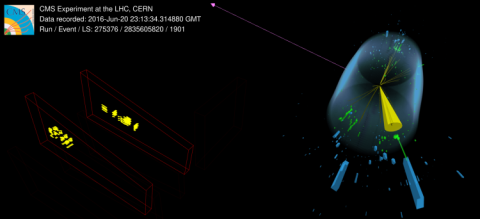
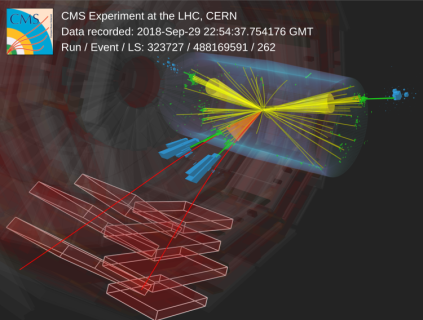
A search for long-lived particles decaying into two muons has been performed by the CMS collaboration. Many scenarios of beyond standard model physics envisage such a possibility, whereby the exotic particles, travel before decaying, a considerable distance which can range from few microns to several kilometres depending on detailed properties. The striking experimental signature of such a phenomena is two muon tracks originating away from the collision region.

A possible new decay mode of the Higgs boson

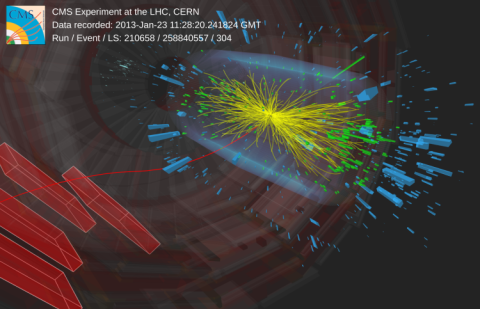
CMS looked for a relatively rare decay mode of the Higgs boson, viz., to a Z boson and a photon (H โ†’ Z๐›พ ). The Z was identified via its decays to electron and muon pairs (e+e- or ๐+ ๐-). The spectrum for the combined mass of the three particles (e+, e- and ๐›พ and ๐+ , ๐- and ๐›พ ) in data showed a small bulge near the measured mass of the H, indicating possible presence of excess events due to the decay H โ†’ Z๐›พ. To be more confident about it, more data is required. Stay tuned!

Two Ends of a Seesaw

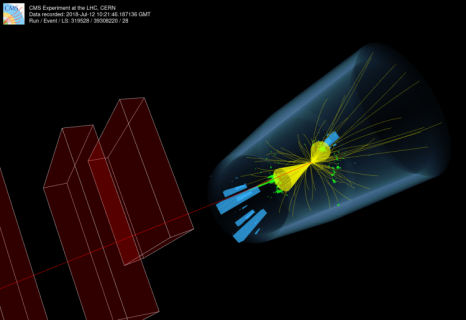
Experiments have established that the neutrinos do have non-zero mass but extremely tiny, though in standard model they are treated as mass-less. This can be explained using theoretical ideas of Majorana and Weinberg. The testable prediction at the LHC is the production of 2 same-sign muons unaccompanied by neutrinos. Data collected by the CMS experiment were found to be compatible with the backgrounds only for such a process, unfortunately.