CMS new management: 2022-2024
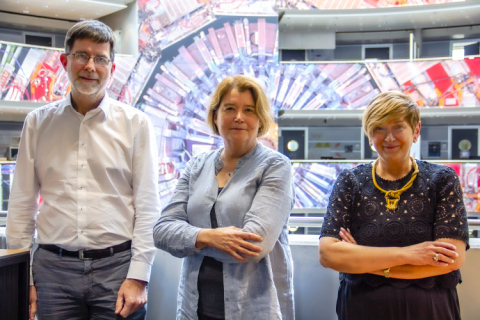
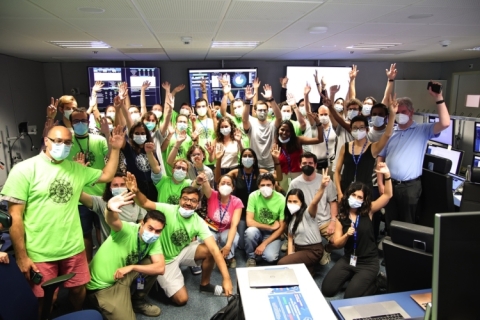
The CMS collaboration welcomes its ninth management team: the new spokesperson, Patricia McBride, and the two deputies, Wolfgang Adam and Lucia Silvestris, will represent the Collaboration for the next two years.

The CMS collaboration welcomes its ninth management team: the new spokesperson, Patricia McBride, and the two deputies, Wolfgang Adam and Lucia Silvestris, will represent the Collaboration for the next two years.
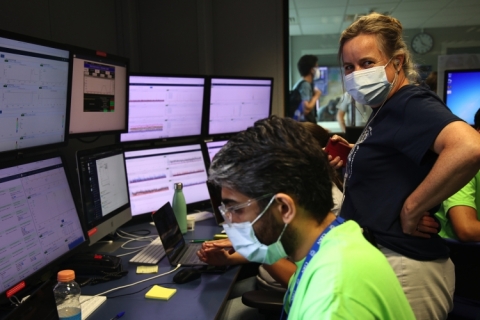
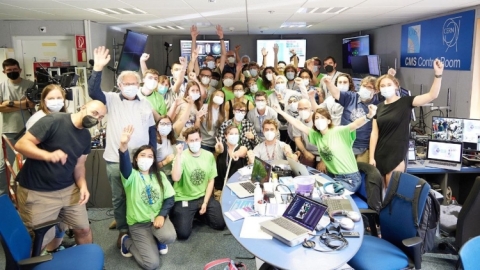
While the CMS detector takes data 24 /7, physicists take turns in the control room every 8 hours, ensuring continuity of operations and keeping the detector running continuously. Experts located around the world are present at all times to respond to requests from the shift crew.
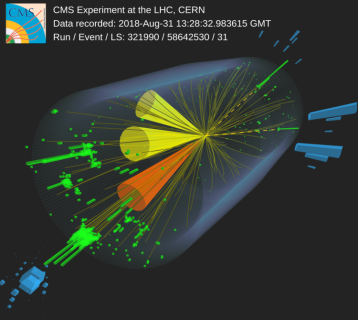
Have you heard of vector-like quarks? They are hypothetical particles which would provide an explanation to the value of the Higgs boson mass, which is still a mystery.
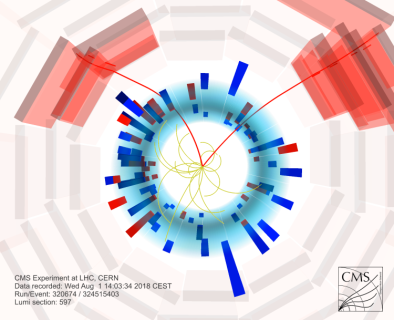
Rare events, such as a total solar eclipse or a supernova explosion, are fascinating and stimulate our imagination. In addition, such events may lead to discoveries expanding our knowledge horizon.
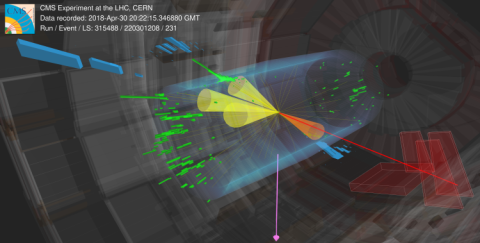
CMS has developed a new method to measure the properties of the top quark with high precision. It relies on an innovative way to cluster particles into jets.
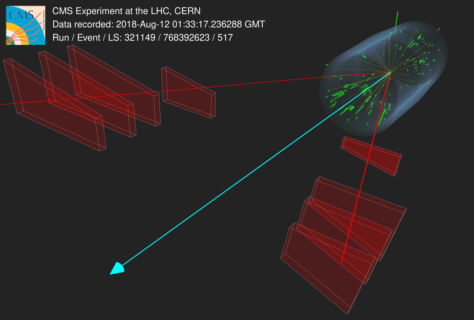
The processes that are mostly studied at the LHC are caused by energetic collisions where the protons break up into their constituents, the quarks and gluons, which recombine to form composite hadrons.
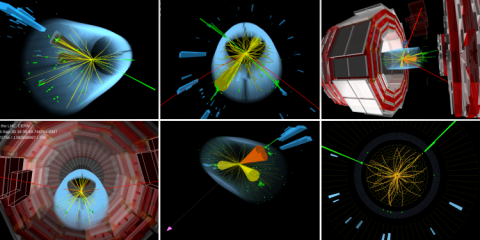
Exactly ten years ago, on the 4th of July 2012, the ATLAS and CMS experiments announced the discovery of a new particle compatible with the long-sought Higgs boson.