




W, Z, and Higgs bosons as portals to exotic physics


Since the LHC collider started operating, more than a decade ago, several trillions of proton-proton collisions have taken place.
Search for double Higgs production with multiple leptons
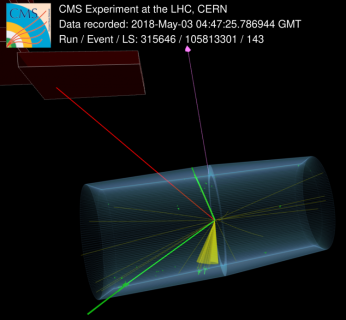
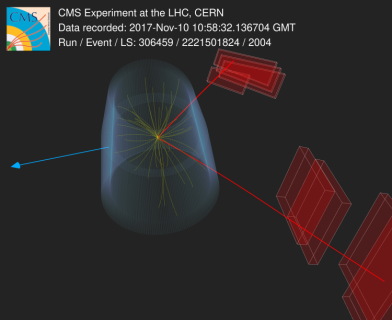
Using events containing multiple leptons, the CMS Collaboration looked for production of a pair of Higgs bosons, but could not find any evidence. However there is some extra events in data with high mass values for the Higgs boson pair when compared with total expectation of Higgs boson pair signal and background. Only with more data the situation can be clarified.
Search for rare production of vector boson pairs
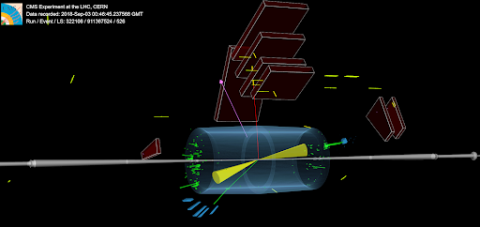
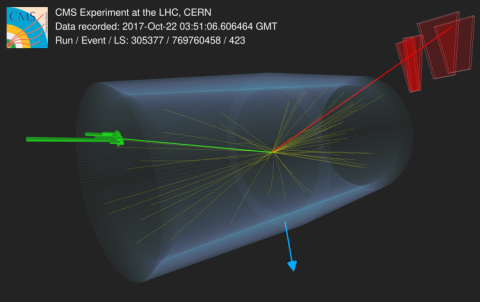
Vector boson (W, Z) scattering process is a purely weak process which have been studied here to investigate interesting characteristics of the standard model and to test new physics scenarios that have a sizable indirect impact on the measurable quantities. This analysis looks for production of two opposite sign W bosons accompanied by a pair of forward-backward jets with large mass and wide separation. In addition there is missing energy in the event due to two neutrinos produced with the muons. Since the rate of this process in standard model is extremely low, using machine learning techniques signal-to-background ratio has been increased considerably allowing observation of the process with good confidence. Nothing usual has been found.