CERN and CMS engineers and technicians have installed the first two of nine required next-generation carbon dioxide (CO2) cooling plants in the underground Service Cavern of the CMS experiment in Cessy, France, as well as two of the accumulators.
What does 2025 hold for CMS?
2024 was an impressive year: the most data ever collected by CMS, many important results including two landmark results (
Art & Science Co-Lab at Art Genève!
Art & Science Co-Lab at Art Genève 2025: A Meeting Point for Creativity and Innovation
The "Large Photon Collider": CMS observes scattering of light by light at the LHC
CMS scientists discover some of the rarest collisions that the LHC can produce – such as the scattering of light by light – and learn more about the quantum nature of electromagnetism, search for new particles, and much more.
CMS Wrapped: A Year in Review
Welcome to our look back at 2024 - and what a year it has been!
New record: 2024 has been the year with the most recorded data by CMS!
The heavy ion Run has just concluded, marking the start of the extended year-end technical stop (EYETS). Reflecting on 2024, this year’s LHC Run exceeded expectations, delivering the highest accumulated data volume to date.
CMS Young Researcher Prize 2024 - The Winners
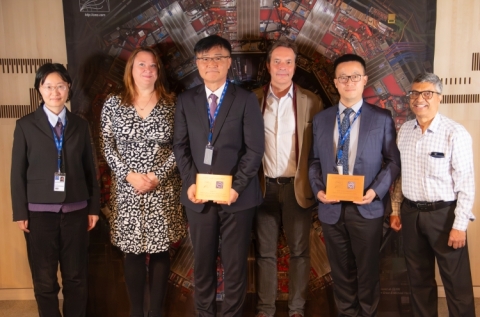
The CMS Collaboration announced the 2024 Young Researcher Prize winners during the opening plenary of December’s CMS Week: Silvio Donato, Kenneth Long, and Stella Orfanelli.
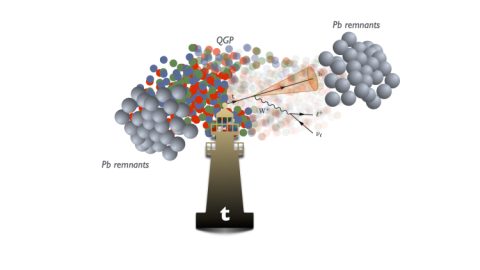
Clocking nature's heaviest elementary particle: Do top quarks play by Einstein's rules the whole day and night?
In a first measurement of its kind at the LHC, the CMS experiment tests whether top quarks adhere to Einstein’s special theory of relativity, and improves the bounds on noncompliance by up to a factor of one hundred with respect to previous results.