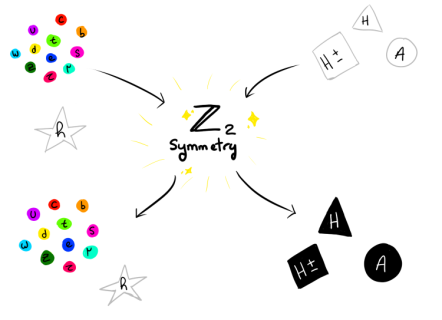
Unlocking the vault of new physics
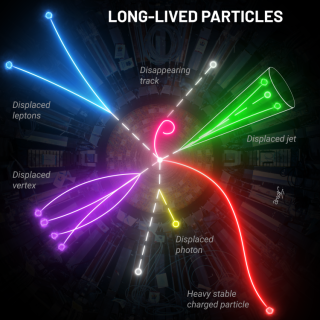
In Run 3, CMS expanded its trigger program to enhance capturing long-lived particles that decay far away from the point of collision – broadening the search for physics beyond the Standard Model.

In Run 3, CMS expanded its trigger program to enhance capturing long-lived particles that decay far away from the point of collision – broadening the search for physics beyond the Standard Model.
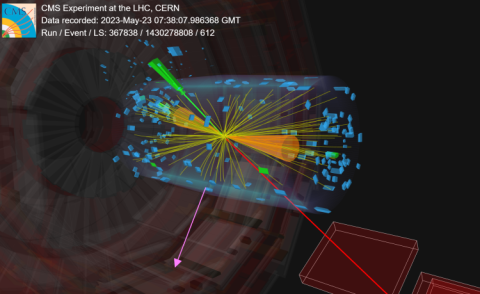
The CMS Collaboration reports the first measurements of the production of same-sign WW and WZ boson pairs in association with two jets at 13.6 TeV, using data collected during 2022–2024.
The CMS Collaboration announces 38 new results for Moriond 2026.
Here are the highlights of what we have presented so far.
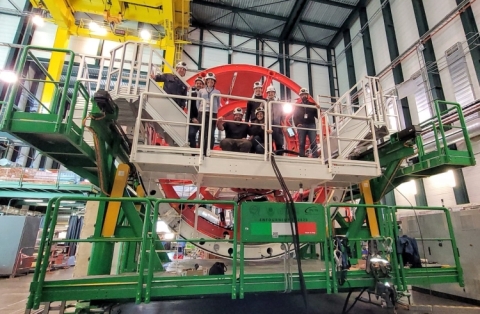
The Electromagnetic Calorimeter (ECAL) group has tested the second enfourneur (pictured above), a highly specialized instrument that allows the insertion and extraction of key components of the CMS
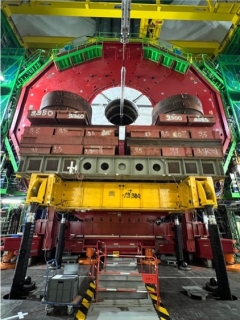
CMS successfully carried out key tests for the lifting system needed in the construction of Hi Lumi CMS during the end of year stop 2025/2026.
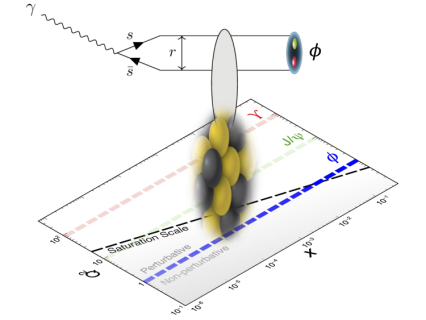
The CMS Collaboration reports the first measurement of coherent ϕ meson photoproduction, establishing a powerful new tool to explore the dense nuclear matter in the transition regime from perturbative to nonperturbative QCD.
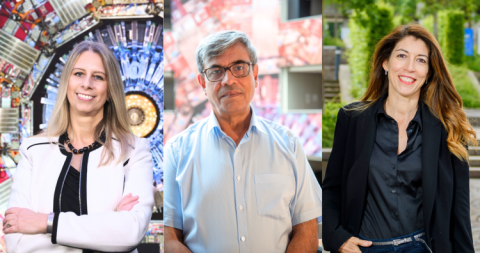
Anadi Canepa has been elected the new CMS Spokesperson 2026 - 2028. Florencia Canelli will join Hafeez Hoorani as Deputy Spokesperson.
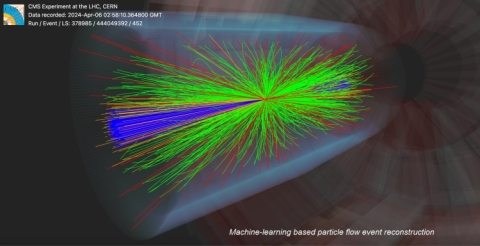
An interactive version of the above event display can be found at this page.
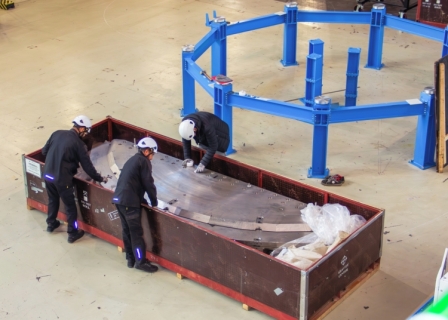
After an eight-week journey, the first HGCAL absorber structure (CE-H1) was delivered to CERN and is ready to be assembled, just 100 metres above where the detector will eventually be located.