
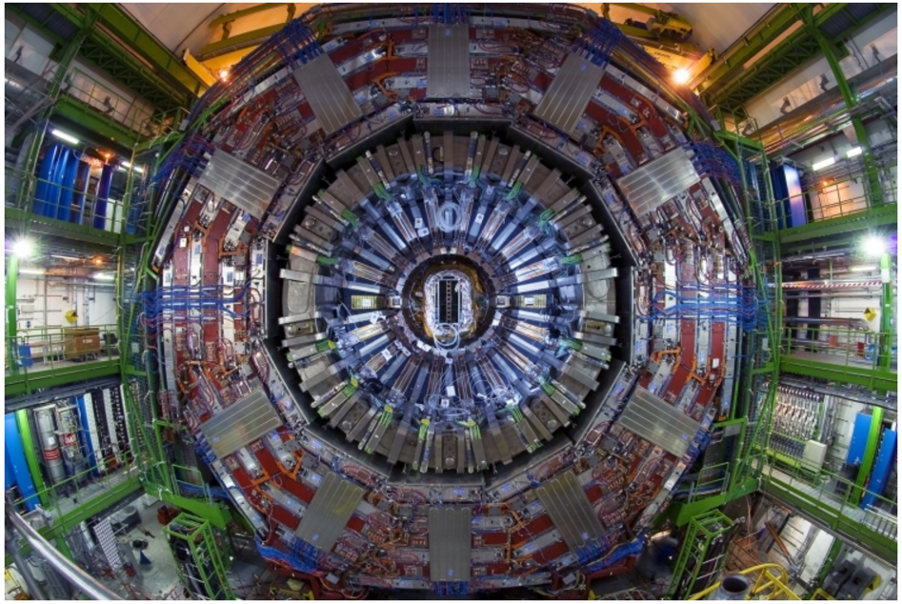

The CMS Collaboration announces 28 new results for ICHEP 2026.
Among the highlights are three new results including 2026 data, and several brand new searches.
The CMS Collaboration is presenting a broad portfolio of new physics results at the 43rd International Conference on High Energy Physics (ICHEP 2026), held in Natal, Brazil, from 30 July to 5 August 2026. The new results span the full breadth of the CMS physics programme, including Higgs boson studies, precision measurements of the Standard Model, top quark and flavour physics, heavy-ion collisions, and searches for new phenomena.
Among the highlights is a stringent upper limit on the branching fraction of the rare decay of the W boson to three hadrons, opening a new avenue for studying hadronic weak decays [SMP-25-011], together with the first observation of high-energy lepton–lepton scattering that probes the electroweak interaction in a previously unexplored regime [SMP-26-008]. These two results exploit the full CMS Run 2 and Run 3 data sets, including the data recorded in 2026, providing the most comprehensive view yet of proton–proton collisions at the LHC.
In Higgs physics, CMS presents an improved search for Higgs boson pair production in the bbττ final state, further advancing the experimental sensitivity to the Higgs self-coupling [HIG-25-008].
The conference also features a new determination of the CKM matrix element Vcb from top-quark decays, demonstrating the potential of top-quark processes to provide complementary constraints on fundamental Standard Model parameters [TOP-26-001]. New flavour-physics results continue to explore the behaviour of heavy-flavoured hadrons and rare decays, while the heavy-ion programme presents new measurements that deepen our understanding of the strongly interacting matter produced in nucleus–nucleus collisions [HIN-25-017]. In addition, CMS recently unveiled a rich set of new results from light-ion and heavy-ion collisions for the Hard Probes 2026 conference, further expanding the collaboration's broad physics programme.
CMS is also reporting a broad range of searches for physics beyond the Standard Model, including new results targeting long-lived particles and other exotic signatures [EXO-25-005]. Together, these analyses showcase the exceptional performance of the CMS detector and the rapidly expanding Run 3 dataset, enabling both increasingly precise tests of the Standard Model and sensitive probes of new physics.
CMS is also presenting a broad portfolio of new detector-performance and reconstruction results. Several of these studies already exploit data recorded in 2026, reflecting the experiment's ability to rapidly translate newly collected data into physics-ready performance measurements. The programme includes proof of concepts for new calibration techniques that will further enhance the precision of CMS measurements [DP-26-106]. Another highlight is forward-looking studies using data from special high-pileup LHC runs in 2025 – with up to 150 near-simultaneous collisions compared to the around 65 in Run 3 – addressing the challenges and opportunities of future LHC operation [DP-26-111]. These developments continue to strengthen the foundations of the CMS physics programme, enabling both increasingly precise measurements and the exploration of new physics opportunities.
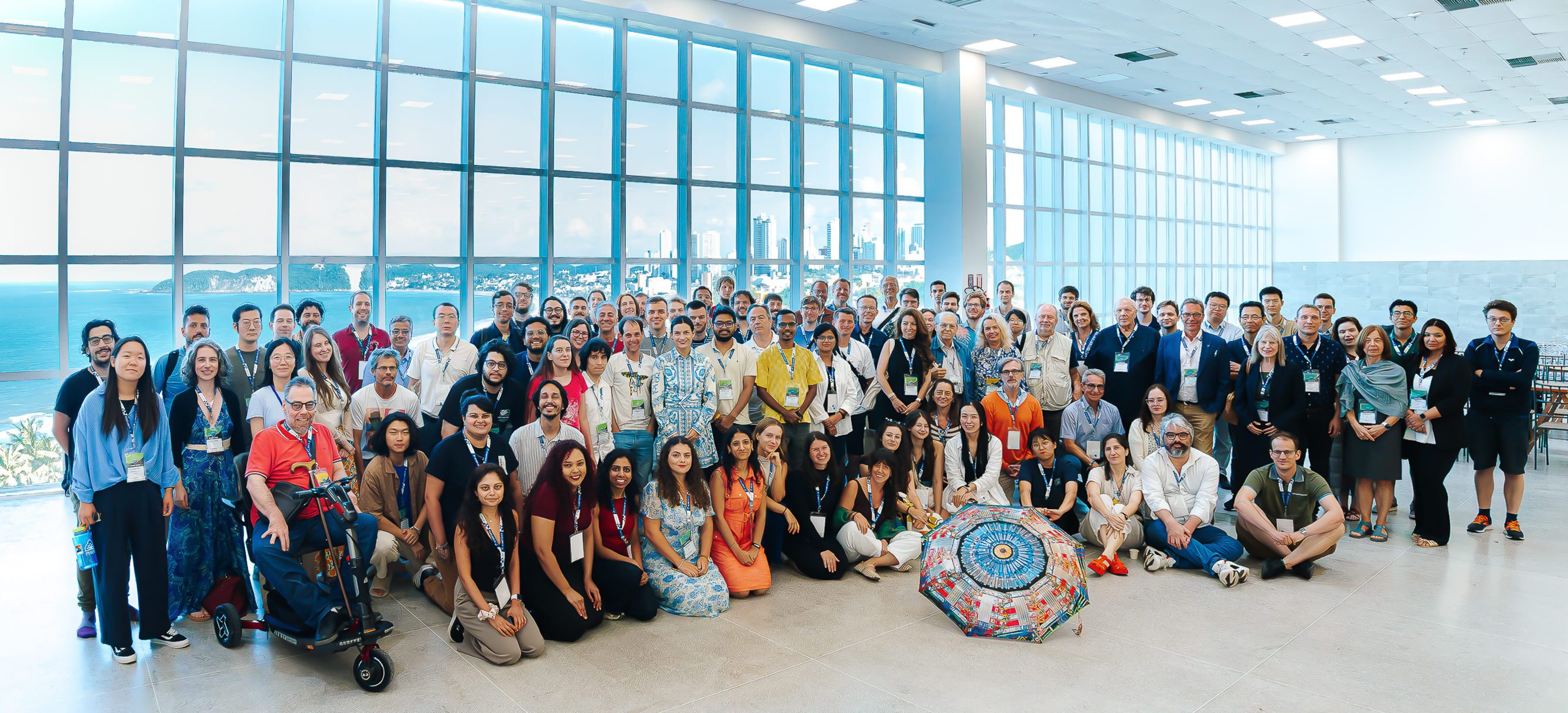
Here is a list of all our new results being presented at the conference. Details about the papers and briefings will be added throughout the conference.
|
Group and identifier |
Title of the study |
Full paper/PAS |
Physics briefing |
|
B2G-24-002 |
Search for heavy higgs bosons in the A → Z(→ ℓℓ)H(→ tt semileptonic) channel |
|
|
|
B2G-24-011 |
Search for new resonances decaying into a pair of Higgs bosons in the bbττ final state in proton-proton collisions at √s = 13 TeV |
|
|
|
B2G-24-019 |
Search for a heavy resonance decaying into a Higgs boson and a new scalar boson using the γγbb final state in proton-proton collisions at √s = 13 TeV |
||
|
BPH-24-005 |
Simultaneous dB/dq2 measurements and isospin asymmetries of rare b→sµ+µ− decays with partial Run 3 data |
||
|
BPH-25-005 |
Search for the rare decay K0S → µ+µ− in proton-proton collisions at √s = 13.6 TeV |
|
|
|
BPH-26-004 |
Observation of η → µ+µ−π+π− and improved measurement of the branching fraction for η → 2µ+2µ− |
|
|
|
EXO-23-012 |
Search for long-lived particles decaying to photons in decays of the Higgs boson at √s = 13 TeV |
|
|
|
EXO-24-010 |
Search for nonresonant production of strongly coupled dark matter at 13 TeV |
|
|
|
EXO-24-024 |
Search for a right-handed W boson decaying into a tau-flavored heavy neutral lepton in proton-proton collisions at √s = 13 TeV |
|
|
|
EXO-24-036 |
Search for inelastic dark matter with low-momentum displaced electrons in proton-proton collisions at √s = 13 TeV |
||
|
EXO-25-001 |
Search for Higgs compositeness effects in high-mass dilepton final states in proton-proton collisions at √s = 13 and 13.6 TeV |
||
|
EXO-25-005 |
Search for long-lived particles with a pair of muon detector showers in proton-proton collisions at √s = 13.6 TeV |
|
|
|
HIG-24-016 |
Search for nonresonant ttHH production in the final state with four bottom quarks and one lepton in proton-proton collisions at √s = 13 TeV |
|
|
|
HIG-25-008 |
Search for nonresonant HH production in the bbττ final state in proton-proton collisions at √s = 13.6 TeV |
||
|
HIN-25-017 |
Measurement of the jet quenching effect with Z + jet events in pp and PbPb collisions at 5.36 TeV |
||
|
MLG-25-001 |
Unsupervised anomaly detection for real-time data acquisition in the CMS Experiment at the Large Hadron Collider |
|
|
|
NPS-25-005 |
Search for Lorentz-boosted Higgs boson decays to a pair of new spin-0 particles in the bbbb final state at √s = 13 TeV |
||
|
NPS-25-008 |
Search for new phenomena in events with energetic jets and large missing transverse momentum in proton-proton collisions at √s = 13.6 TeV |
|
|
|
SMP-24-011 |
Measurement of inclusive W+W− and tt cross sections with one τ lepton in the final state in proton-proton collisions at √s = 13.6 TeV |
|
|
|
SMP-25-002 |
Combined effective field theory constraints from multiboson production at √s = 13 TeV |
|
|
|
SMP-25-004 |
Measurement of the differential cross section for inclusive isolated photon production in proton-proton collisions at √s = 13.6 TeV |
|
|
|
SMP-25-009 |
Measurement of 4-point energy correlator projections in Z+jets events |
||
|
SMP-25-010 |
Measurement of normalized double-differential groomed and ungroomed jet mass cross sections in Z+jet events at √s = 13 TeV with the CMS detector |
|
|
|
SMP-25-011 |
Search for W boson decays to three charged hadrons |
||
|
SMP-26-008 |
Observation of lepton-lepton scattering in proton-proton collisions at √s = 13 and 13.6 TeV |
||
|
SMP-26-015 |
Observation of the production of high-pT jets or electroweak bosons with an intact forward proton in pp collisions at √s = 13.6 TeV |
||
|
SUS-24-008 |
Search for exotic decays of the Higgs boson into a pair of light bosons with two b jets and two photons in the final state with full Run 2 dataset at 13 TeV |
|
|
|
TOP-26-001 |
Measurement of the |Vcb| element of the CKM matrix from top quark pair events in proton-proton collisions at √s = 13 TeV |
|
Here is a list of all our detector performance notes released since Hard Probes 2026.
|
Detector note identifier |
Title of the study |
Link to the note |
Physics briefing |
|
DP-26-094 |
Output rates and bandwiths of the High-Level Trigger during 2025 & 2026 PbPb runs |
|
|
|
DP-26-095 |
Identifying quenched jets in CMS using machine learning |
|
|
|
DP-26-096 |
Pixel detector performance in 2025 |
|
|
|
DP-26-097 |
Evolution of the HLT Scouting of the CMS experiment in 2022 -- 2026 during LHC Run 3: statistics |
|
|
|
DP-26-099 |
Retrained ParticleNet for AK8 bb-tagging at HLT |
|
|
|
DP-26-100 |
Alpaka-based pixel digi morphing for radiation damage mitigation at the CMS HLT |
|
|
|
DP-26-101 |
Primary vertex and track impact parameter resolutions in the 2022, 2023, 2024 datasets with the CMS Phase-1 pixel detector |
|
|
|
DP-26-102 |
CMS silicon strip tracker performance results with 2025 data |
|
|
|
DP-26-103 |
Performance of boosted top quark identification based on jet substructure at √s = 13.6 TeV using data collected in 2022, 2023 and 2024 |
|
|
|
DP-26-104 |
The global particle transformer for boosted-jet tagging and mass regression: development and performance from v1 to v3 |
|
|
|
DP-26-105 |
Global particle transformer for HLT Scouting at CMS |
|
|
|
DP-26-106 |
Generative-modeling based calibration of flavour tagging algorithms at the CMS experiment |
|
|
|
DP-26-107 |
RPC 2025 performance |
|
|
|
DP-26-108 |
Performance summary of AK4 jet b tagging with data from 2024 proton-proton collisions at √s = 13.6 TeV with the CMS detector |
|
|
|
DP-26-109 |
Jet energy scale and resolution measurements using Run 3 data collected by CMS in 2025 and 2026 at 13.6 TeV |
|
|
|
DP-26-110 |
Wide-cone jet substructure tagging in the CMS Phase-2 Level-1 Correlator Trigger |
|
|
|
DP-26-111 |
Performance of jet, missing transverse momentum, and (machine-learned) particle flow reconstruction in pp collision data with more than 100 pileup interactions at the CMS experiment |
||
|
DP-26-113 |
Speeding up the electron pixel seeding using GPUs |
|
|
|
DP-26-114 |
Accelerated tracking for a high-throughput Phase-2 NGT HLT Scouting stream: Computing and Physics performance |
|
Read more about these results:
-
@CMSExperiment on social media: Bluesky - Facebook - Instagram - LinkedIn - TikTok - Twitter/X - YouTube