CMS presents new results at the EPS-HEP 2019 Conference

The CMS collaboration is presenting several new results at the 2019 European Society of Physics’s High-Energy Physics conference (EPS-HEP) taking place in Ghent, Belgium.

The CMS collaboration is presenting several new results at the 2019 European Society of Physics’s High-Energy Physics conference (EPS-HEP) taking place in Ghent, Belgium.
Managing the amount of data from the Large Hadron Collider (LHC) collisions is a major challenge for CMS physicists. The detector produces more than 500 terabytes of data per second.
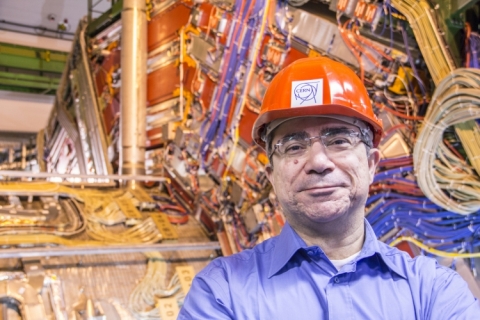
Paraskevas Sphicas, CMS' former co-Deputy Spokesperson of CMS (2014-2016), and CMS physics coordinator during the crucial phase from 2006 to the start of data taking, was elected as Fellow of the prestigious Royal Society of the UK and the Commonwealth.
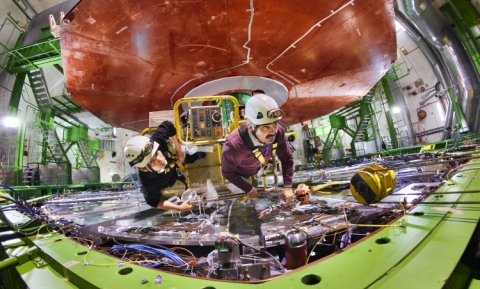
After the LHC was shut down in December 2018 following the successful completion of RUN 2 operation, CMS is undergoing an intensive upgrade and maintenance program during the current two-year break (“Long Shut
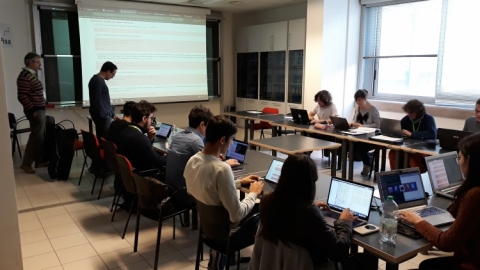
This year, the CMS Data Analysis School (CMSDAS) celebrates a decade of hands-on trainings, exercises and challenges involving several hundreds of CMS members for the benefit of some 1500 students.
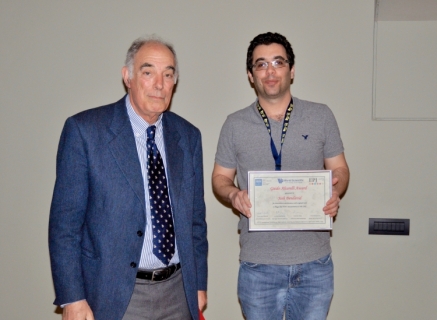
This year the 27th conference on Deep Inelastic Scattering and Related Subjects (DIS2019), is being held in Torino. As a part of the conference, the "Altarelli Prize" is awarded to a person with research experience in the fields covered by the DIS conference series.

During LS2, CMS will install 144 additional muon detector modules specially designed to detect particles produced in the very forward region.

Suppose that you need to see what is inside a small room that is difficult to access. Thick walls between you and the object of your investigation; you cannot dig, and the closest that you can get to the target is inside a narrow tunnel, with no electricity to power your instrumentation.

Observation of two excited Bc mesons and first Bc(2S) mass measurement using the LHC data collected in 2016, 2017 and 2018. In November 2018 the proton-proton running of the LHC Run 2 ended. The data collected in 2018 is the largest ever collected at the LHC. Just under three months after the final proton proton collisions were collected, the CMS collaboration has submitted the first paper using this dataset. This reflects an immense achievement as substantial levels of computing on the level of data calibration and reconstruction is necessary to be able to use the data for analyses at the level that it is suitable for a scientific result.

The CMS detector is built from several different layers, surrounding the beam pipe in which the LHC beams collide. The subdetector that is closest to the collisions is the pixel detector.