CMS Collaboration publishes its 1,500th paper
In October 2026, the CMS Collaboration published its 1,500th scientific paper in a peer-reviewed journal.
By CMS Collaboration

From the discovery of the Higgs boson and detailed studies of known particles and hadrons to investigations of quark–gluon plasma and searches for dark matter and new phenomena, each paper tells the story of an extraordinary quest to understand the universe.
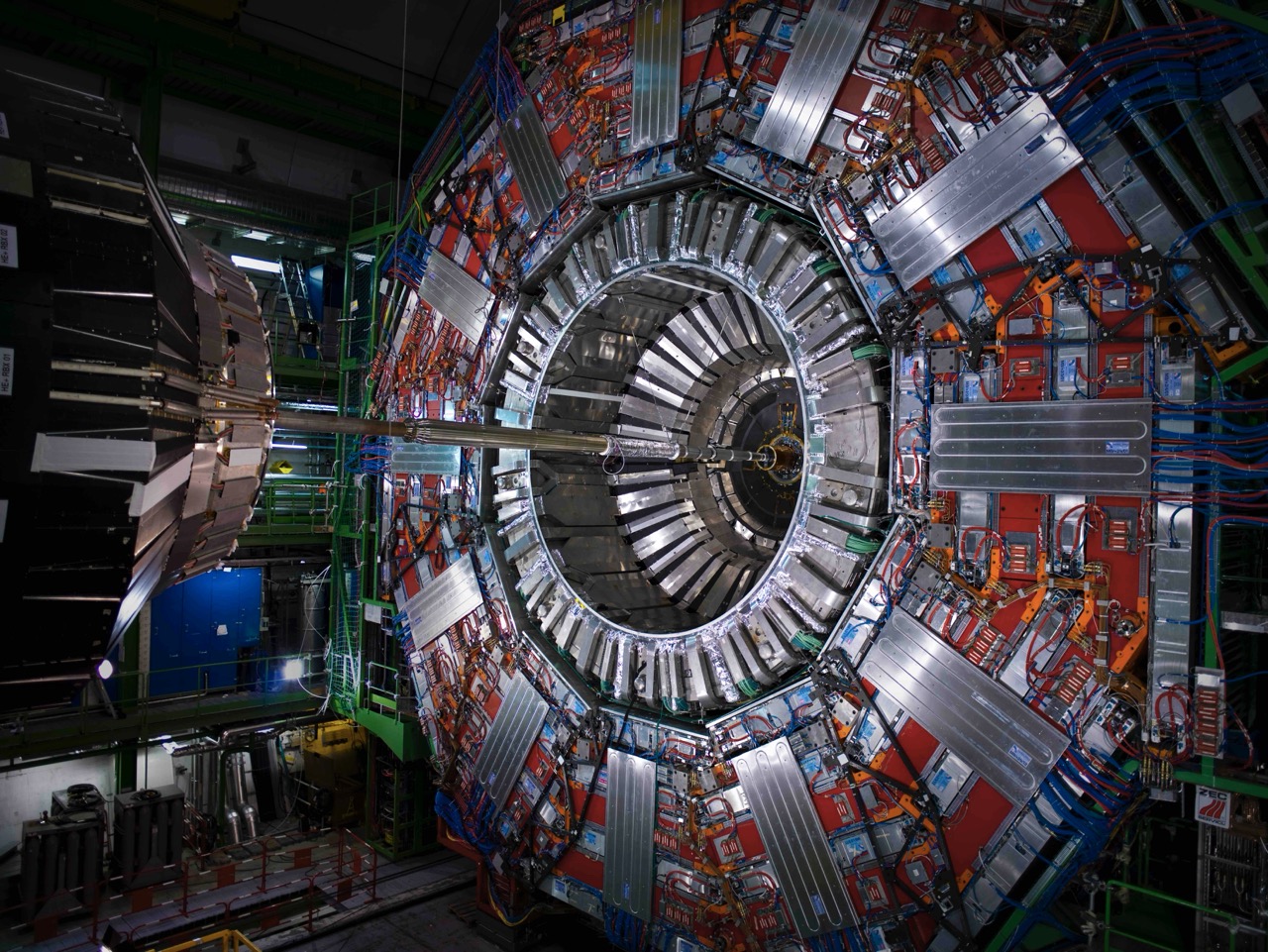
On 14 August 2008, the CMS Collaboration published its first paper in a peer-reviewed journal, “The CMS experiment at the CERN LHC”. It described the design of the detector that would soon begin recording the results of particle collisions at the Large Hadron Collider (LHC). Eighteen years later, the collaboration has reached a remarkable milestone – 1,500 published papers, reflecting the remarkable breadth of its scientific programme, from precision measurements and discoveries to searches for new phenomena.
“Reaching 1,500 published papers is a remarkable achievement,” says Anadi Canepa, spokesperson for the CMS Collaboration. “Each paper is a testament to the ingenuity and dedication of our 6,000 collaborators, whose collective efforts enabled the construction and operation of the detector and analysis of the data it collects, producing scientific results of the highest quality.”
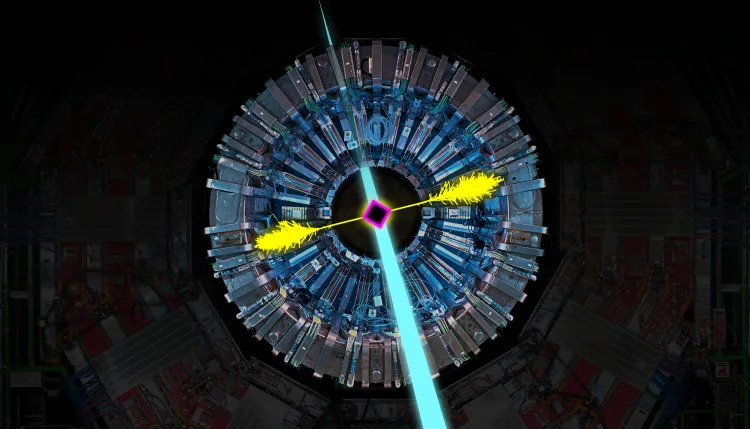
In total, CMS papers have received 218,883 citations – 111,695 excluding self-citations – highlighting their impact on high-energy physics research. The artwork at the top of this article depicts this scientific legacy in one frame, combining one figure from each CMS paper to form the collaboration’s logo [view the full-resolution image here].
A discovery and a new beginning
The most celebrated milestone in CMS’s publication history came in 2012, when CMS and ATLAS jointly announced the discovery of the Higgs boson. CMS’s 183rd paper, “Observation of a new boson at a mass of 125 GeV with the CMS experiment at the LHC”, reported the landmark finding. It has since become the collaboration’s most cited paper, with 17,190 citations, at the time of writing.
But the observation of the Higgs boson was only the beginning. Subsequent CMS papers have explored how the Higgs boson decays, how it interacts with other particles, and whether its properties agree with theoretical predictions. A comprehensive account of the measurement of the Higgs boson’s properties during the second run of the LHC (2015–2018) was presented in the recently published paper “Combined measurements and interpretations of Higgs boson production and decay in proton-proton collisions at √s= 13 TeV”.
The precision achieved in these measurements far surpassed the original projections, enabled by advances in machine learning techniques and more sophisticated real-time selection of collision events.
Testing the known
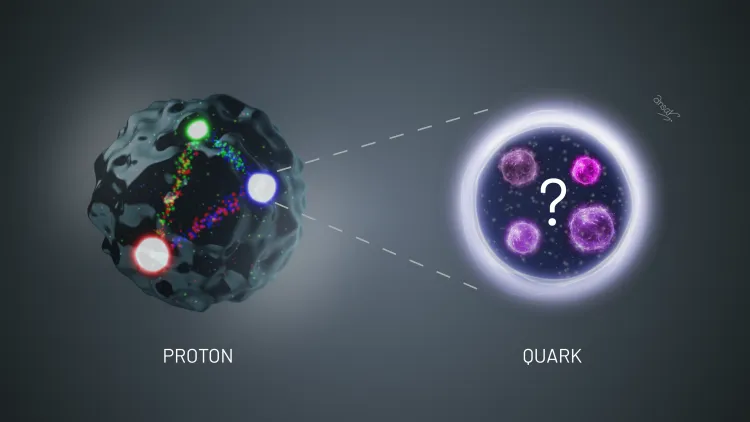
Hundreds of CMS papers have refined measurements of known particles and processes, including increasingly precise studies of the W and Z bosons, interactions between quarks and gluons, and the production of jets – collimated sprays of particles created in high-energy collisions. These measurements also probe the internal structure of the proton itself, studying the distributions of quarks and gluons within it. These are essential inputs for interpreting almost all other results at the LHC. Comparing these measurements with theoretical predictions from the Standard Model of particle physics reveals whether our understanding of the subatomic world holds at the highest energies ever probed.
The paper “High-precision measurement of the W boson mass with the CMS experiment” set a new standard for precision measurements at the LHC, reporting the mass of the W boson with an uncertainty of just 0.01%.
Another major focus is measuring the production and properties of the heaviest known elementary particle, the top quark, including its mass, its interactions, and the ways it is produced alongside other particles. Recently, the CMS paper “Observation of a pseudoscalar excess at the top quark pair production threshold” attracted attention worldwide by reporting an intriguing excess of events that raises the possibility of a short-lived, bound-state-like system formed by a top quark and its antiquark.
Rare decays with big implications
Some of the most sensitive tests of the Standard Model come from studying how particles containing different types, or “flavours”, of quarks transform and decay. CMS has published observations and studies of rare decays of B hadrons – particles containing a bottom quark – and other bound states of quarks, even previously unobserved ones. In 2015, CMS and LHCb jointly reported the landmark observation of the exceptionally rare decay of the B0s meson into a muon–antimuon pair.
CMS has since expanded its flavour-physics programme by introducing dedicated trigger systems and specialised high-rate data collection streams. These developments have allowed CMS to study processes containing bottom and charm quarks in even finer detail and publish results with sensitivities on par with dedicated flavour-physics experiments.
Recreating the early universe
When heavy nuclei collide inside the LHC, they can create an extreme state of matter known as quark–gluon plasma. In this exotic medium, quarks and gluons are no longer confined within protons and neutrons but can move collectively. Scientists think that this state of matter filled the universe during its first few millionths of a second. CMS has published numerous studies of lead–lead collisions to investigate how this plasma forms, and to examine its remarkable properties.
In 2010, CMS published a landmark paper reporting the first observation of an unexpected “ridge” pattern in proton–proton collisions. It challenged existing assumptions about the behaviour of collision systems, suggesting that collective effects, previously associated mainly with heavy-ion collisions, could also emerge in proton–proton collisions.
In July 2025, the LHC collided oxygen nuclei and neon nuclei for the first time. CMS quickly analysed the newly collected data and published the results within just a few months. An example, “System-size dependence of charged-particle suppression in ultrarelativistic nucleus-nucleus collisions”, compared the energy lost by quarks and gluons in the aftermath of oxygen–oxygen, neon–neon, xenon–xenon, and lead–lead collisions. The results demonstrated signs of energy loss in all these collision systems, offering clues about the possibility of plasma-like behaviour in small-scale nuclear systems too.
Searching for what lies beyond
Despite the remarkable success of the Standard Model, many fundamental questions remain unanswered. CMS therefore pursues an extensive programme of searches for new phenomena that could point to a more complete theory of nature. These include searches for dark matter, undiscovered heavy particles, supersymmetry, “long-lived” particles that travel measurable distances before decaying, underlying structure within elementary particles, and much more.
Although these searches have yet to reveal new phenomena, CMS has continued to narrow down the possibilities, placing increasingly stringent constraints on theories beyond the Standard Model. The 2025 paper “Dark sector searches with the CMS experiment” gives a comprehensive account of a broad range of searches for hypothetical particles and interactions associated with a possible dark-matter sector.
Building tools for the exploration
Over the years, CMS has pioneered detector technologies and experimental techniques to probe the subatomic world. Alongside its physics results, the collaboration has published important papers documenting the detector, its performance, and methods to reconstruct and interpret collision events.
The 2017 paper “Particle-flow reconstruction and global event description with the CMS detector” described how CMS combines information from its different detector systems to reconstruct individual particles and build a complete picture of each collision. The approach has been a cornerstone for CMS analyses for more than a decade.
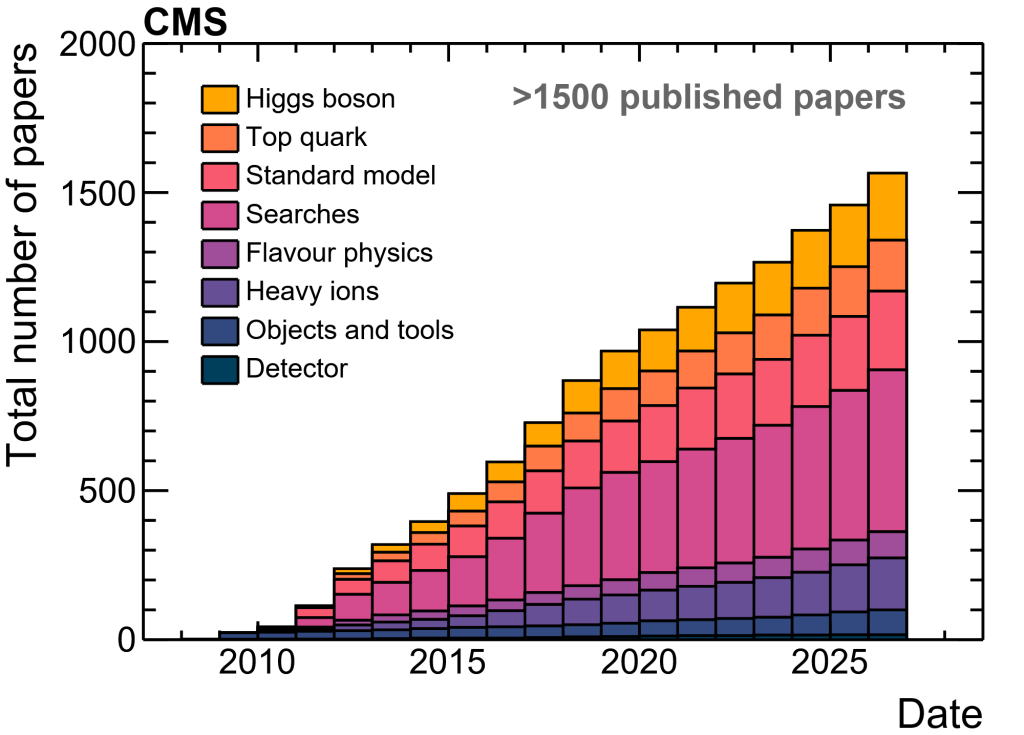
Above: Total number of CMS publications by topic (stacked) over time.
Every CMS paper represents much more than a set of results. The data are collected through a complex choreography between the LHC and the CMS detector systems, and then processed and stored by a computing infrastructure that handles petabytes of data. Analysing these data involves years of research, careful checks, and rigorous scrutiny. Before publication, results undergo extensive internal review within the collaboration and independent peer review by scientific journals. This process helps ensure that observations, measurements, and constraints all meet the highest standards of scientific reliability.
In Summer 2026, the LHC completed its third long run and entered a four-year period of extensive upgrades, which will enable CMS to gather five times as much collision data in the next ten years of operation as it has recorded until now. Whilst the ambitious upgrade programme is underway, CMS will continue analysing the datasets already collected, with the majority of the scientific results from its third run still to come. New measurements, searches, and publications will continue throughout the upgrade period and beyond.
What will the next 1,500 papers reveal? Perhaps they will uncover hints for a new particle, expose a subtle crack in our current theories, or provide an unexpected clue to one of the universe’s greatest mysteries. One thing is certain – the quest is far from over.
Written by: Muhammad Ansar Iqbal, for the CMS Collaboration